Tuesday, May 28, 2013

Rely on the Spirit

On Saturday December 2, 1989, in my last area, we tracted into an older gentleman named Ben and set up an appointment for the following evening.  We ended up teaching him for three hours.  We met Ben at his office, which was filled with Born Again literature, instead of in his home.  We started teaching the first discussion and got through the Joseph Smith story.  When we started talking about the Book of Mormon, Ben asked why another book was necessary.  “We are all prophets and apostles,” he said.  Then he asked us to find one truth in The Book of Mormon that is not in the Bible.

I started flipping pages and praying for help, but I did not seem to get an answer.  So I prayed harder.  Meanwhile, my companion brought up the doctrine of eternal marriage.  As my companion and Ben hashed over Matthew 22:25-30, I had a very strong impression from the Spirit.  It said, “Every truth in The Book of Mormon is in the Bible, yet more clearly explained in the Book of Mormon.”  I was then impressed to turn to Moroni Chapter 8 and ask Ben for his feelings on infant baptism.  He said it was wrong and unnecessary and quoted the Apostle Paul as saying, “Before I had the law I was alive, but once I had the law I was dead.”  I agreed with him and then read Moroni 8:12.  He agreed with the passage and this served to confirm the earlier impression that I had received.

We talked about a few other things but eventually came back to the Book of Mormon.  My comp asked Ben if he would accept more scripture if God brought it forth.  We had to make sure that he understood that it was God that was doing it.  He answered that he would only accept it if he could find a foundation for it in the Bible.  He then repeated his challenge about finding a truth in the Book of Mormon that is not in the Bible.  The impression I got from the Spirit at this point hit me like a brick.

I said, “Wait, just a moment ago you said that if you could not find foundation for something in the Bible you would not accept it.”  Then I asked, “How can we find a truth in the Book of Mormon that is not in the Bible if you will not accept anything without a foundation for it being in the Bible?”  That got him.  He hemmed and hawed for a moment and then said that he meant a truth he had not yet found in the Bible.  “Sir,” I said, “you give us an impossible challenge, for we are not mind readers and we cannot know what you do and do not know.”  Again, he hemmed and hawed before again reissuing his challenge.

It was at this point that we concluded our meeting.  We had to hurry home so that we could be on time for the First Presidency’s Christmas Devotional satellite broadcast.  But first, I tried to give Ben my testimony and tell him how I knew these things were true.  He passed it off as irrelevant.  We gave him a copy of the Book of Mormon and challenged him to read and pray about it.  Then we departed.

Throughout this whole experience, my companion and I each had some big impressions from the Spirit.  My companion later told me that he had one impression that kept repeating; it said, “If you believe not these words, you believe not in Jesus Christ.”  He thought it was a scripture and kept asking for the reference.  Meanwhile, as Ben was bashing the Book of Mormon, we both felt the Spirit and knew that it was independent of anything he said.  In a situation where our faith might have been shaken, we both knew by virtue of the spirit that the Book of Mormon was true.  There simply could be no doubt.

During the April 2012 General Conference, President Henry B. Eyring said that "We never need to feel that we are alone or unloved in the Lord’s service because we never are. We can feel the love of God. The Savior has promised angels on our left and our right to bear us up. And He always keeps His word."  My companion and I were not left alone during our three hour teaching appointment with Ben.


In the Doctrine and Covenants we read, "Neither take ye thought beforehand what ye shall say; but treasure up in your minds continually the words of life, and it shall be given you in the very hour that portion that shall be meted unto every man. . . . And whoso receiveth you, there I will be also, for I will go before your face. I will be on your right hand and on your left, and my Spirit shall be in your hearts, and mine angels round about you, to bear you up" (D&C 84:85, 88).

Finally, in John 14:26, we read, "But the Comforter, which is the Holy Ghost, whom the Father will send in my name, he shall teach you all things, and bring all things to your remembrance, whatsoever I have said unto you."


Missionaries need to study the scriptures and rely on the Holy Ghost. if they do that, they may receive help from the Spirit when teaching.  It is important to note, however, that the Comforter cannot bring something to our remembrance that we have not studied.



Monday, May 27, 2013

Christ-Centered Healing from Depression and Low Self-Worth

I know what you are thinking, why am I writing about depression? Discouragement, frustration, and even depression can impact missionaries.  The work is often difficult, many areas are slow, some companions are impossible to get a long with, each of these things can lead to discouragement and even depression.  Hard working missionaries may become disillusioned as they see other, less-hard working missionaries have the success they themselves are not having.  Missionaries experiencing adversity may start questioning their self worth if they blame themselves for lack of success.  Any of these things can lead to the downward spiral of depression.

It seems that I have always had to deal with what used to be called melancholia, much like Abraham Lincoln.  But I think that I experienced my first real depressive episode as an adult while on my mission.  I had been out nearly 18 months and was experiencing the challenge of a difficult companion.  This elder had been with me earlier in the MTC, and he arrived in our area with a reputation for working as hard, or not, as his companion.  In fact, however, by the time we were assigned to work together, he had given up.  He said one day that he didn't know why he was on a mission, and I wanted to tell him to figure it out soon because I knew why I was there and I had work to do.

Well, I didn't say that, as I didn't think it would be appropriate.  I learned quickly that I could not motivate this elder to work; he often slept through the morning and was rarely ready to go until the afternoon.  With each passing day my frustration grew.  One of our zone leaders suggested that I get ready to go and then go outside and stand by my bike; the idea being that perhaps my companion would get the idea, get ready, then come out and join me.  When I tried this I was out by my bike for 15 to 20 minutes, but my companion never came outside.  After I finally gave up, I went back into the apartment to find my companion sitting on the couch eating breakfast -- he hadn't even realized I was outside!

Frustration turned into anger which turned into discouragement.  I read a statement in a book a number of years ago which said that bitterness can turn into self-blame, even when such blame is not supported by the facts.  Adding to my self-blame was the simple fact that I was the senior companion, therefore I was responsible.

We were assigned together for three months and we hardly worked because sooner or later I gave up trying to motivate my companion to work.  In third month, in an interview with the mission president, I took full responsibility for the lack of work, and his disappointment in me was another dagger to my heart.  I prayed every night for forgiveness, but it was without faith because of my depression.

You might be surprised to learn, by the way, that during these three difficult months, we actually had two baptisms.  I can't say that either were the result of hard work on our part, though I did try to do my best when given the opportunity to teach these individuals when we received referrals to them from members in our area.

Perhaps a depressive episode such as the one I experienced is rare among missionaries; yet, perhaps, depression may be more prevalent than we might expect.  Certainly, missionaries can count on experiencing discouragement.  The following videos may contain some helpful information for dealing with discouragement and depression, even for missionaries.  The first video contains some highlights from a talk given by Carrie M. Wrigley, a licensed clinical social worker (LCSW) in 2005 at BYU Eduction Week.  The second video is of the entire 55 minute talk by Sister Wrigley.


The second video can be found here (link):

http://www.byutv.org/watch/76dec84f-0d69-4f60-90fd-38cc41bb51aa/byu-education-week-carrie-m-wrigley-2005


Friday, May 24, 2013

Every Home Can Be A Mini-Missionary Training Center

Create a mini-missionary training center in your home as you help your children prepare for future missions.  In this video, Elder Russell M. Nelson teaches about the in-home preparation of future missionaries.
 

Thursday, May 23, 2013

Write Away!

As I wrote yesterday, we spent the first night after the earthquake in a tent.  Before turning in we continued to listen to news coverage on the radio.  Later, the folks across the street had hooked a television up to a generator, and we went over to watch for awhile.  Obviously, missionaries are not supposed to listen to the radio or watch TV, but these were exceptional circumstances.  We had heard about some of the damage caused by the quake, and now we got to see some of it.

They kept repeating over the radio that we should stay off the phone in order to free up the lines for emergency services.  I am the type that when emergency services make such a request, I happily comply.  The other missionaries assigned to Watsonville, however, all called home.  Our distract leader was even interviewed over the phone by his hometown newspaper.  I did ask my companion to ask his parents to call my parents and let them know that we were safe and well.  Unfortunately, something got lost in transmission; not understanding that we were all okay, my parents worried even more.

My next mistake was not immediately writing home.  Instead I spent the next week and a half writing first a very long journal entry, and then a very long letter, recounting everything that had happened, with plenty of details.  Naturally, this did not make my parents happy.  The lesson here is that if you're not going to call home, you should at least drop a postcard in the mail the next day saying that all is well.  Another suggestion, don't write home suggesting to your parents that they should prayed to know if you are safe and well.

Still, it could have been worse.  A month after the earthquake I got a new companion; he transferred in from Hollister, on the other side of the mountains from Watsonville.  Apparently, the missionaries in Hollister spent more than one night in a tent.  My new companion told me that they spent a couple of weeks in a tent, apparently waiting for someone to tell them it was safe to go back inside their apartment.  My companion made the unfortunate mistake of writing in a letter home that he was still living in a tent.  You can imagine what happened; his parents called the mission president demanding to know why their son was still living in a tent, after which the mission president called the elders in Hollister wanting to know just what in the world they were thinking.

Another lesson is no matter how bad things get, don’t tell your parents the worst of it.  As long as you are safe and healthy, that’s the important thing.  As I wrote to my nephew, then serving in Michigan, instead of writing, “Door knocking in a blizzard is fun,” it should be, “More snow this week, all is well.”  Mothers are known to worry about their sons.  “What do you mean you’re living in a tent?!”  “You’re tracting in a blizzard?!  What is wrong with you?!” Even though they announced on the news after the quake that all the missionaries in the area were fine, mothers will still worry.

Even when there isn't a major disaster, parents will worry any time they don't get a letter.  Yet there are some weeks, particularly later on in a mission, where you just don't feel there is anything to write about.  "Another week tracting, no teaching appointments, all is well," might seem like a rather unexciting letter, but it's probably better than no letter.

At the same time, some parents will not realize that it can be a big disappointment when their missionary does not receive letters from home.  I found it particularly troubling when, after I missed writing home one week, I got a lecture from my parents.  I had the temerity to fire right back about the weeks they missed writing me.  Don't do that.

Instead, you might try sending home a photo of you standing next to an empty mailbox with a sad countenance.  Or you can quote from Alma 60:6: "And now behold, we desire to know the cause of this exceedingly great neglect; yea, we desire to know the cause of your thoughtless state."

Meanwhile, as Watsonville recovered from the earthquake, we essentially forgot about proselytizing for the next month -- outside of a few teaching appointments.  Instead we volunteered with the Red Cross at the Buddhist Temple, as well as volunteering to help many families clean up.  We helped one family whose chimney had collapsed, obliterating the easy chair the husband would have been sitting in to watch game three of the world series if he hadn't had a dentist appointment instead.


Wednesday, May 22, 2013

Suriving a Major Disaster on a Mission

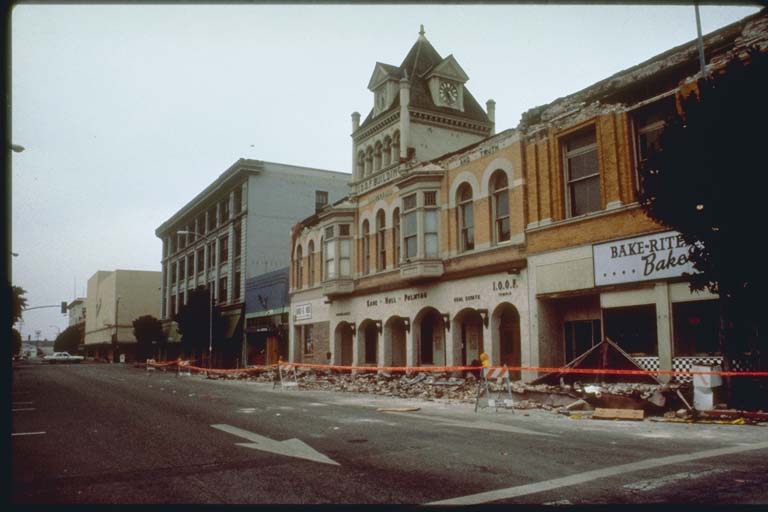
October 17, 1989, started out as just another day in Watsonville, California.  We went back to our apartment for an early dinner around 5:00 p.m. and my companion decided to take a nap while I ate.  As I started to eat I heard a rolling/shaking sound outside, arcing toward the apartment, then the building began to shake.  My first thought was, "Oh, we get an earthquake today."  I had experienced a few other earthquakes in the 21 months I had been in California, and they were small quakes, each under 5.5 on the Richter scale.  It quickly became obvious, however, that this was not going to be a small quake.

Our apartment building was no longer on solid ground; it was as if we were aboard a small ship being tossed violently by heavy seas.  The shock waves of the quake would pick the building up and then drop it, over and over again.  BANG! BANG! BANG!  At this point my comp woke up from his nap, thinking I was playing some kind of practical joke on him.  The shaking intensified and books started falling off shelves.  We both jumped up and collided with each other on our way to the nearest door jamb.  As we stood there, I was conscious of nothing but the quake; I did not see the havoc being raised around me.

It was 5:04 p.m., and my companion and I, and everyone else in Watsonville, were just 17 miles from the epicenter at Loma Prieta.  According to official reports, the earthquake lasted just 15 seconds, to me it seemed more like three minutes, it just went on and on and on.  When it finally ended I gradually became aware of my surroundings, and the first thing I noticed were the chandeliers -- balls at the end of a chain -- swinging around overhead.  We didn't see much else as we decided to get out as fast as we could.  We crossed the street to a park and waited, not knowing what to do.  A man came by with a radio, and as we listened, we learned about the major disaster that had hit the Bay Area.

That night we slept in a tent.  The next day we traveled around Watsonville, seeing the devastation first hand -- houses burned down after gas leaks were ignited, houses that had jumped off their foundations, building facades that had crumbled, and a large crack in the downtown shopping center.  I saw porches that had collapsed and wondered what would have happened if we had been out tracting when the quake hit.  There was a long line at the grocery store as people lined up to buy bread and water.  Everywhere we heard rumors of another, bigger earthquake to hit sometime that day or night.

We went back to our apartment and had a barbeque lunch -- we were still without electricity.  Then we took a nap to catch up on lost sleep.  We were awoken by a knock on the door, it was our mission president, his wife and the A.P.s; they had come to check on us because we weren't home when they had called us on the phone.  They told us that church headquarters in Salt Lake City knew that all of the missionaries were safe, and that an announcement would be made on the news.

That night we decided to sleep in our apartment, but we were all experiencing a little fear and trepidation due to the rumors of a bigger quake.  As I prayed before going to bed, I thanked my Heavenly Father for my life, my safety and my shelter. I then explained my fears and anxieties about the rumors of another quake, and then asked for forgiveness for my weakness. I asked that he would help my lack of faith and then I asked if there would be another earthquake. I said that I knew there would be more aftershocks, but I wanted to know if there would be any more major earthquakes. The spirit gave me a sweet assurance there would be no more big quakes and I was blessed with peace.

There were more aftershocks that night; in fact, there seemed to be an aftershock every hour on the hour.  A particularly big aftershock at 2:00 a.m. woke me up.  My heart was beating fast, but I said to myself, No, have faith. There can be no faith where there is fear. He promised that there would not be another big quake. Trust Him!”  A bigger aftershock around 3:00 a.m. woke us all up and we each ended up out in the living room. We listened to the radio for a few minutes.

By a quarter to 4:00, my companion, our district leader and his companion were asleep on the living room floor. I could not sleep and did some more reading by candlelight. By 4:30 a.m., I was also asleep on the living room floor. Thirty minutes later a big aftershock hit. Again I repeated, “No, trust Him.” That was the last aftershock of the night. The Lord kept his promise. By 8:00 a.m. then next morning we had electricity again. It felt like a turning point.  Later I wrote in my journal, "What an experience, though, to be able to go to a loving Heavenly Father and ask him if there would be any more big earthquakes, and then to receive an answer! What a confirmation of His love!"

I testify that Heavenly Father hears and answer prayers, and will give us peace when we need it, if we but ask Him in prayer.

Tomorrow I will write a little about what not to do regarding your parents after a major disaster.  I wrote about my fears; imagine how my parents must have felt. 


Thursday, May 16, 2013

The Whole Armor of God

"It is important that we make up our minds early in life as to what we will do and what we will not do" counseled President N. Eldon Tanner in the April 1979 General Conference. "Long before the moment of temptation comes we should have determined that we will resist that cigarette, that drink of whiskey, that act of immorality, or anything that will keep us from enjoying the companionship of the Spirit of the Lord. We all have different weaknesses and temptations, and we should examine our lives to find out what those weaknesses are and where we should put on extra armor so we can do what is right and not submit to temptation."

The talk can be found here:

http://www.lds.org/general-conference/1979/04/put-on-the-whole-armor-of-god?lang=Eng&clang=eng

It is my belief that when a member of the Quorum of the Twelve or of the First Presidency is speaking, past or present, we should be paying attention.

In October 1975, President Spencer W. Kimball addressed the General Relief Society meeting.  His talk contains counsel that can apply to all members, including missionaries.  "Temptations are great," said President Kimball. "Satan tells us that black is white. He lies to us; therefore, we must be prepared to make a bold stand before Satan, who is without flesh and blood, and against principalities and powers and the rulers of darkness. We need the whole armor of God that we may withstand. We must quench the fiery darts of the wicked with the shield of faith."

This talk can be found here:

http://www.lds.org/ensign/1976/03/the-blessings-and-responsibilities-of-womanhood?lang=eng

In the April 1974 General Conference, Elder L. Tom Perry spoke about how his parents clothed him each day.  "We were dressed in our home each morning, not only with hats and raincoats and boots to protect us from physical storm, but even more carefully our parents dressed us each day in the armor of God. As we would kneel in family prayer and listen to our father, a bearer of the priesthood, pour out his soul to the Lord for the protection of his family against the fiery darts of the wicked, one more layer was added to our shield of faith. While our shield was being made strong, theirs was always available, for they were available and we knew it."

That talk can be found here:

https://www.lds.org/general-conference/1974/04/build-your-shield-of-faith?lang=eng

In the October 1986 General Conference, President Gordon B. Hinckley quoted President Wilford Woodruff, who said, “There are two powers on the earth and in the midst of the inhabitants of the earth—the power of God and the power of the devil. In our history we have had some very peculiar experiences. When God has had a people on the earth, it matters not in what age, Lucifer, the son of the morning, and the millions of fallen spirits that were cast out of heaven, have warred against God, against Christ, against the work of God, and against the people of God. And they are not backward in doing it in our day and generation. Whenever the Lord set His hand to perform any work, those powers labored to overthrow it”

President Hinckley went on to say, "The victims who fall are as precious as those who have fallen in the past. It is an ongoing battle. . . . The war goes on. It is waged across the world over the issues of agency and compulsion. It is waged by an army of missionaries over the issues of truth and error. It is waged in our own lives, day in and day out, in our homes, in our work, in our school associations; it is waged over questions of love and respect, of loyalty and fidelity, of obedience and integrity. We are all involved in it -- men and boys, each of us."

President Hinckley's talk can be found here:

https://www.lds.org/general-conference/1986/10/the-war-we-are-winning?lang=eng

Excerpts from some of these talks were used in this video:


Missionaries, just like the rest of us need to put on the whole armor of God.


Tuesday, May 7, 2013

Finding People to Teach

No, this is not going to be a discussion on tracting, street contacting, or working with members to get referrals -- though I might point out that while converts can be found from tracting (I found two), referrals from members is the way to go as referrals lead to more converts than tracting.  Rather, this post is about finding people to teach mock discussions to, for those doing missionary prep as a DIY project, or whose prep program does not offer the opportunity.  Randy L. Bott, a former mission president, has this suggestion:

"Home teaching is the most often overlooked teaching opportunity.  At least once a month, young men have the opportunity to teach in a situation that parallels the missionary experience more closely than any other.  You and your companion visit a family to teach them the gospel of Jesus Christ.  Remarkable!  But what if your senior companion always teaches the lesson?  Well, why don't you shock him by volunteering to teach the next one?  If he is hesitant (which he won't be), remind him that you are trying to develop your teaching skills for your mission."

You might start off just teaching from the First Presidency message in the Ensign, but ask your companion if you can also teach one, two or even all of the discussions -- this will also give you experience in lesson planning.  "You would be light years ahead of other missionaries," writes Randy Bott, "if you could enter the MTC with the experience of teaching all [five] discussions.  You would know what questions to ask your MTC instructors, and you would know your strengths and weaknesses.  As you teach you will be more motivated to learn the scriptures and doctrines as you discuss sacred things with others."  Young women can have this same opportunity through Visiting teaching, though phone contacting is sometimes permitted if visits are hard to schedule.

Teaching mock discussions will have many benefits.  "Many missionaries," write Bott, "are shy and lack confidence in their ability to teach effectively.  These skills can be strengthened a great deal with a little experience.  Month after month you will see different reactions to different teaching styles.  You will need to adjust your style to meet people's needs rather then expecting others to accommodate your style.  Encourage them to ask questions so you will develop skills in answering.  The moment of truth is when you ask them to evaluate your teaching.  If they are honest, they will have some suggestions in areas where you might improve."

If you feel ready to teach more often than once a month, you might try talking to other families in your ward, at church or on the phone, and asking them if you could teach them a discussion.  This will give you some experience in contacting people and setting appointments.  "These people love you and want you to succeed," writes Bott.  Well, some of them might at least like your parents.  In any case,  "They will be much more patient than many investigators who haven't developed those feelings of closeness.  Try to change your weaknesses into strengths before you leave."

If you find the idea of teaching your home teaching families, or other families in the ward daunting, perhaps the best place to start is in your own home, during family home evening.  "It is difficult for Mom and Dad to always teach the lesson," writes Bott.  "What a pleasant surprise (more like shock!) if you volunteer to teach regularly.  If you start early enough, you will gain adequate experience in teaching almost all the gospel principles in a friendly setting before being thrust into a sometimes hostile environment.  Do yourself a favor and learn how to teach."

Another teaching opportunity you might seek would be to volunteer to teach a class at church.  Missionaries often have the opportunity to teach investigators who attend church in a gospel principles class during Sunday School.  Missionaries called to serve teaching in a foreign language sometimes teach English classes.  There are still other opportunities for teaching such as "at youth conferences, firesides, and discussion groups."

"Although you may feel afraid or anxious about teaching others," writes Bott, "you should realize that you have something worthwhile to say.  Choose a topic relevant to the audience you are addressing.  Try to get them involved by asking and answering questions and making observations.  You will soon discover how difficult it is to carry the entire load yourself.  When everyone is involved, teaching becomes enjoyable.  Don't ever turn down an opportunity to speak, because preparation forces us to learn.  Also, the challenge of teaching allows us to grow."


Source: Bott, R. L. (1995). Prepare with Honor: Helps for Future Missionaries. Salt Lake City: Deseret Book.