Wednesday, June 12, 2013

"You Use It, You Wash It"

It seems like a simple, straightforward rule; if you use a dish or utensil, then you should wash it.  Yet some missionaries I knew seemed to have a very difficult time following it.  When I had been out about 15 months, I was in a four-man flat; my comp and I always washed the dishes we used, but the other two elders hardly ever did.  One evening my comp, and I got fed up with the status quo.

When we came back to the flat for dinner we found few clean dishes, so we decided to play a joke on the other two elders. We boxed up all the dishes – both clean and dirty – and hid them in the shed behind the apartment building where we kept our bikes. Then we went off to a teaching appointment. 

Later, after we returned to the flat, I sat down in the living room and started studying.  Elder Davis (names have been changed to protect the innocent) came out of his bedroom and went into the kitchen where I  heard him open and close some cabinets. Then he came out to the living room and said, “Did you know the dishes are missing?” I thought for a moment and then said, “Elder Fox stole our dishes?"

Elder Fox was in our zone and had previously lived in this particular apartment.  While living in that flat he apparently discovered a way to break in (maybe he locked himself out one day) and after being transferred he apparently broke into the apartment and took some stuff on a few occasions -- so he was the perfect fall guy.  I do not know how I kept a straight face.  The elder then said, “I know, can you believe it?” After he left the room I went into the bathroom and started laughing. 

The humor continued the next morning when our zone leaders came by with a box of dishes.  At that point my comp and I figured it was time to let the cat out of the bag. So my comp revealed that we had hid the dishes in the shed. Elder Baker got a kick out of the whole thing and he said, “Elder Wells told me you probably hid them in the shed and I said nah they're not stupid enough not to look there!” It was good for a laugh.

I'd like to say that the other two elders always washed their dishes after that, but that is not how things turned out.

It has been said that some companions are blessings while other companions are trials -- when you are with someone 24/7 even small faults can be magnified.  The same could be said of other missionaries in your apartment, district or zone.  The ability to get along with others is a valuable skill.  An important aspect of getting along with others might be to pull your own weight -- in other words, do your dishes!


Monday, June 10, 2013

“The Work of Salvation” Missionary Broadcast

From LDS.org:

"Ward and stake council members, their spouses, full-time missionaries, and other interested Church members are invited to participate in a special session of the Seminar for New Mission Presidents entitled “The Work of Salvation,” which will be broadcast from the Marriott Center in Provo, Utah, on Sunday, June 23, 2013, at 4:00 p.m. mountain daylight time. The program will be subsequently rebroadcast to many areas of the world. President Thomas S. Monson, President Boyd K. Packer, and members of the Quorum of the Twelve Apostles will share messages about missionary work and conversion."

This sounds like an excellent opportunity for prospective missionaries and their parents.  In addition to church satellite system broadcasts, there will be live video and audio-only broadcasts on the Internet via LDS.org, mormonchannel.org and facebook.com/lds.  Sunday, June 23, at 4:00 p.m. is the only time the seminar will be available via mormonchannel.org and facebook.com/lds.  The broadcast will be available at LDS.org to be viewed at any time until the video archives are made available.  Video and audio-only files will be available at LDS.org within 24 hours of the broadcast.

The Mormon Channel app is available for a variety of electronic devices. Examples include streaming players, such as Roku, and tablets and smart phones, such as those running the Apple (iOS) or Android operating systems. Check your device’s channel store or app store for the app, or visit mormonchannel.org to learn more.  The program will be available in the archives within several days of the broadcast.

This broadcast will also be available live in English on Mormon Channel HD Radio. Visit mormonchannel.org for more information.

Links:

https://www.lds.org/church/events/the-work-of-salvation-missionary-broadcast?lang=eng 

https://www.lds.org/callings/melchizedek-priesthood/records-and-technology-support/bc/clerksupport/pdf/meetinghouse-tech/broadcasts/11984_000_letter.pdf?lang=engeng


Thursday, June 6, 2013

Always Acknowldege Your Sins and Weaknesses

"Do not say: O God, I thank thee that we are better than our brethren; but rather say: O Lord, forgive my unworthiness, and remember my brethren in mercy -- yea, acknowledge your unworthiness before God at all times" (Alma 38:14).  This was council given by Alma the younger to his son Shiblon, which followed the mission to the Zoramites, in which Shiblon took part.  The preceding verse reads: "Do not pray as the Zoramites do, for ye have seen that they pray to be heard of men, and to be praised for their wisdom."

Perhaps one of the reasons the story of the Zoramites was included in the record is that Mormon wanted to give us an example of what not to do.  Not long after Alma, Shiblon and the other missionaries assigned to the Zoramites arrived in the land of Antionum, they witnessed a rather unusual ritual.  The people had built synagogues where they gathered once a week to take turns standing upon a high platform -- which was called a Rameumptom -- to recite a certain prayer:

"Holy, holy God . . . we believe that thou hast separated us from our brethren and we do not believe in the traditions of our brethren . . . but we believe that thou hast elected us to be thy holy children . . . and again we thank thee, O God, that we are a chosen and a holy people. Amen" (Alma 31:15-18).

We have been blessed to receive the restored gospel of Jesus Christ, and we are a "peculiar people," so there can be a temptation to think that we are elected or chosen, and therefore better than those who have not received the things that we have.  Let us be clear, this kind of thinking leads us into dangerous ground.  The moment we start thinking that we are better than others is the moment we lay ourselves open to the dangers of pride.

I do not recall who said it, but someone once suggested that the children of Israel misunderstood why they were a chosen people.  They were not chosen because they were better than other people -- and a reading of the Old Testament makes it clear that they were not always better -- but rather they were chosen so that by them others might be blessed.  So it is with us, we have been called so that others might be blessed through our efforts to share the restored gospel of Jesus Christ.  Let us also remember that while many are called, few are chosen (D&C 121:34).

"And why are they not chosen?  Because their hearts are set so much upon the things of this world, and aspire to the honors of men, that they do not learn this one lesson -- That the rights of the priesthood are inseparably connected with the powers of heaven, and that the powers of heaven cannot be controlled nor handled only upon the principles of righteousness.

"That they may be conferred upon us, it is true; but when we undertake to cover our sins, or to gratify our pride, our vain ambition, or to exercise control or dominion or compulsion upon the souls of the children of men, in any degree of unrighteousness, behold, the heavens withdraw themselves; the Spirit of the Lord is grieved; and when it is withdrawn, Amen to the priesthood or the authority of that man" (D&C 121:34-37).


The author of this section, the prophet Joseph Smith, went on to say, "We have learned by sad experience that it is the nature and disposition of almost all men, as soon as they get a little authority, as they suppose, they will immediately begin to exercise unrighteous dominion. Hence many are called, but few are chosen.

"No power or influence can or ought to be maintained by virtue of the priesthood, only by persuasion, by long-suffering, by gentleness and meekness, and by love unfeigned; By kindness, and pure knowledge, which shall greatly enlarge the soul without hypocrisy, and without guile" (D&C 121:39-42).


While Joseph was writing about the priesthood, we can see a larger application.  As John Knox put it, "You cannot antagonize and influence at the same time."  We can only influence, at least in a positive way, by persuasion, long-suffering, gentleness, meekness, kindness and by love unfeigned.  Love can move mountains.

One of the greatest men I have known was my mission president, in many ways he was like a second father to me.  The missionaries in my mission had interviews with the president every other month; as I recall the missionary was asked to open the interview with a prayer and the president closed it with a prayer.  In any case, I noted that my mission president always acknowledge our sins and weaknesses in his prayers.  I have tried to follow this example.

We are all human and therefore we all have weaknesses, and as Paul said, "For all have sinned and come short of the glory of God" (Romans 3:23).  We need not think that we are better than others for there is plenty of evidence to the contrary.

Finally, remember the words of King Benjamin: "I say unto you that if ye should serve him who has created you from the beginning, and is preserving you from day to day, by lending you breath, that ye may live and move and do according to your own will, and even supporting you from one moment to another -- I say, if ye should serve him with all your whole souls yet ye would be unprofitable servants" (Mosiah 2:21).

This is why we need the Atonement, "for we know that it is by grace that we are saved, after all we can do" (2 Nephi 25:23).

Wednesday, June 5, 2013

Bees and Beehives

In their biography of Admiral Arleigh "31-Knot" Burke, Ken Jones and Hubert Kelley, Jr. refer to a particular task force of U.S. ships as "the Navy's floating bee hive."  This force was the famous Fast Carrier Task Force, also known alternatively as Task Force 58/38, in which Burke served as chief of staff to the force commander, Admiral Marc A. "Pete" Mitscher.  At various times during 1944 and 1945, this task force would number between 15 and 17 aircraft carriers with about 1,000 aircraft of three different types -- fighters, dive bombers and torpedo bombers.  This force would sweep the seas and skies of Japanese shipping and aircraft.

I thought of this recently when reading Elder M. Russell Ballard's October 2012 conference talk "Be Anxiously Engaged," in which he discussed his father's work with Beehives.  "My father always tried to involve me in his work with his hives," said Elder Ballard, "but I was very happy to let him tend to his bees. However, since those days, I have learned more about the highly organized beehive -- a colony of about 60,000 bees."  He went on to explain that "It is estimated that to produce just one pound (0.45 kg) of honey, the average hive of 20,000 to 60,000 bees must collectively visit millions of flowers and travel the equivalent of two times around the world. Over its short lifetime of just a few weeks to four months, a single honeybee’s contribution of honey to its hive is a mere one-twelfth of one teaspoon."

While one-twelfth of a teaspoon might seem insignificant, Elder Ballard said that "each bee’s one-twelfth of a teaspoon of honey is vital to the life of the hive. The bees depend on each other. Work that would be overwhelming for a few bees to do becomes lighter because all of the bees faithfully do their part."  This is not unlike the contribution of each man, each plane and each ship to the success of Task Force 58 during World War II.

"All of this symbolism," said Elder Ballard, "attests to one fact: great things are brought about and burdens are lightened through the efforts of many hands 'anxiously engaged in a good cause' (D&C 58:27), Imagine what the millions of Latter-day Saints could accomplish in the world if we functioned like a beehive in our focused, concentrated commitment to the teachings of the Lord Jesus Christ."

More "beehives" can be found in the mission field in missions, stakes, wards and branches.  The daily activities of a single pair of missionaries may sometimes appear insignificant, but taken with the activities of more than a hundred missionaries they can become powerful, still more so when taken with the activities of tens of thousands of missionaries world wide.  But still more 'bees" may be employed in the work as missionaries seek to involve members.  As has been noted previously in this blog, the majority of baptisms result from member referrals.

Additionally, we read about church members around the world giving humanitarian service after natural disasters such as earthquakes, floods, hurricanes and tornadoes.  "But what about our everyday lives," asked Elder Ballard.  "What would be the cumulative effect of millions of small, compassionate acts performed daily by us because of our heartfelt Christian love for others? Over time this would have a transformative effect upon all of our Heavenly Father’s children through the extension of His love to them through us. Our troubled world needs this love of Christ today more than ever, and it will need it even more in the years ahead."

Elder Ballard went on to say, "These simple, daily acts of service may not seem like much in and of themselves, but when considered collectively they become just like the one-twelfth teaspoon of honey contributed by a single bee to the hive. There is power in our love for God and for His children, and when that love is tangibly manifest in millions of acts of Christian kindness, it will sweeten and nourish the world with the life-sustaining nectar of faith, hope, and charity."

Many of us dutifully attend our church meetings and work hard in our callings, but what about the rest of the week?  Are our minds and our hearts just as anxiously engaged in good things during the other six days, or are we just going through the motions?  Are we truly converted to the gospel of Jesus Christ?  It is possible even for missionaries to simply go through the motions in their daily activities.  So, "How do we take the seed of faith that has been nurtured in our minds and plant it deep in the fertile soil of our souls?   How do we make the mighty change of heart that Alma says is essential for our eternal happiness and peace?" (see Alma 5:12-21).

Elder Ballard gave this answer, "Only when our testimony transcends what is in our mind and burrows deep into our heart will our motivation to love and to serve become like unto the Savior’s. It is then, and only then, that we become deeply converted disciples of Christ empowered by the Spirit to reach the hearts of our fellowmen."  He then added:

"When our hearts are no longer set upon the things of this world, we will no longer aspire to the honors of men or seek only to gratify our pride (see D&C 121:35-37). Rather, we take on the Christlike qualities that Jesus taught:

  • We are gentle and meek and long-suffering (see D&C 121:41).
  • We are kind, without hypocrisy or guile (see D&C 121:42).
  • We feel charity toward all men (see D&C 121:45).
  • Our thoughts are always virtuous (see D&C 121:45).
  • We no longer desire to do evil (see Mosiah 5:2).
  • The Holy Ghost is our constant companion, and the doctrines of the priesthood distill upon our souls as the dews from heaven (see D&C 121:45-46)."
Elder Ballard then made clear that he was not encouraging zealotry or fanaticism.  "Quite the contrary! I’m simply suggesting that we take the next logical step in our complete conversion to the gospel of Christ by assimilating its doctrines deep within our hearts and our souls so we will act and live consistently—and with integrity -- what we profess to believe."

Once again he asks, "How do we make this change?  How do we ingrain this love of Christ into our hearts?"  The answer:

"There is one simple daily practice that can make a difference for every member of the Church, including you boys and girls, you young men and you young women, you single adults, and you fathers and mothers.  That simple practice is: In your morning prayer each new day, ask Heavenly Father to guide you to recognize an opportunity to serve one of His precious children. Then go throughout the day with your heart full of faith and love, looking for someone to help. Stay focused, just like the honeybees focus on the flowers from which to gather nectar and pollen. If you do this, your spiritual sensitivities will be enlarged and you will discover opportunities to serve that you never before realized were possible."

He went on to say "President Thomas S. Monson has taught that in many instances Heavenly Father answers another person’s prayers through us through you and me -- through our kind words and deeds, through our simple acts of service and love."  This echoed something President Spencer W. Kimball said: “God does notice us, and he watches over us. But it is usually through another person that he meets our needs. Therefore, it is vital that we serve each other” (Teachings of Presidents of the Church: Spencer W. Kimball [2006], 82).

Missionaries, of course, should be praying multiple times each day for guidance, so that they may be led to those who are ready to hear the gospel.

Elder Ballard's talk can be found here:



Thursday, May 30, 2013

Renaissance, Reformation, Revolution, Restoration

In yesterday's post I talked about my Four Rs presentation.  I can recall sitting in a history class one day, during my sophomore year in high school and the topic being discusses was the Protestant Reformation.  It suddenly hit me that the Reformation was an important precursor to the Restoration, and more thought led to the same conclusion about the Renaissance and the American Revolution (War for Independence).  A few years later I heard a presentation by the motivational speaker Hyrum Smith which covered the history from the Great Apostasy to the Restoration.  Later, on my mission, I had occasion to address some concerns by investigators by going over this history, and I basically did it off the top of my head -- I had an excellent memory in those days.

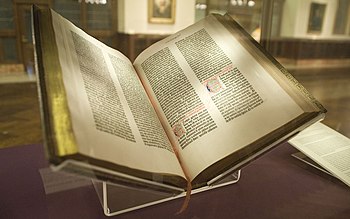
However, as I did it off the top of my head, and my memory was not infallible, I did make a few mistakes.  For example, I said the invention of the printing press enabled Martin Luther to read the Bible, but as a priest in the church he would have had access to the Bible even without the printing press.  Even so, the printing press (movable type) did make the Bible available to those outside of the clergy, and this did have a role in leading to the Reformation.  The Gutenberg Bible, printed in the 1450s, was the first major book to be printed with movable type in the West.

Another mistake I made was to state that Constantine had declared Christianity to be the state religion of Rome.  Constantine did have an important role to play when he gave Christians the freedom to worship in 313 A.D.  It was the Edict of Thessalonica by Theodosius I, Gratian, and Valentinian II in 380 A.D. which determined that all their subjects should profess the faith of the bishops of Rome and Alexandria. This made the Christian Church of the Nicene Creed the official state religion of the Roman Empire.

Speaking of the Nicene Creed, this was the result of an ecumenical council which met in Nicaea in 325 A.D. Before the council at Nicaea, there was a lot of controversy over the nature of the Godhead. One group believed that Jesus was an ordinary man who became the Christ and Son of God at his baptism; another group taught that in the role of the Son, God is manifested in the flesh as a human, in order to bring about the salvation of mankind; and a third group argued the Father was a superior and distinct being from the Son, and that the Son was a superior and distinct being from the Holy Spirit. The Council of Nicaea adopted a term for the relationship between the Father and the Son that from then on was seen as the hallmark of orthodoxy; it declared that the Son is "of the same being" as the Father. This was further developed into the formula "three persons, one being".

If the Council of Nicaea and the Creed it produced does not demonstrate why we need continuing and modern revelation, I don’t know what does.

It might be useful for missionaries to have some understanding of the history, though an in depth knowledge might not be required.  I might suggest a little research of the following topics at Wikipedia (as long as you're not writing a college paper, Wiki should be okay).

Constantine the Great and Christianity:


Edict of Thessalonica:


Council of Nicaea:


The Crusades:


The Renaissance:


The Gutenberg Press:


The Gutenberg Bible:


Martin Luther:


The Reformation:


Henry VIII:


The puritans:


Roger Williams


Wednesday, May 29, 2013

Never Bash, Part III

I was out about a year and in my third area when we tracted into Dave and taught him the first discussion about God, Jesus Christ, Joseph Smith and The Book of Mormon.  He told us that he was also studying with the Jehovah's Witnesses.  A few days later we went back to see him and he had some questions and concerns which we tried to answer.  In answer to one question I told him how I got my testimony.  His biggest concern was the scripture in Revelations 22 about man adding to the Bible.

After a few tries at answering, like referencing Deuteronomy 4, I finally said, “You’re right, man cannot add to the Bible.  I cannot go and write my own book and call it scripture, I cannot add.  But if God spoke to a prophet on this continent and commanded him to write it down and then preserve it from generation to generation and then brought those records forth to give to us, it is scripture.  It is God who has added to the Bible, and not man.  God can add; nowhere in that scripture does it say that God cannot add.  God can do anything he sets his mind to.  So, if The Book of Mormon is true, then God gave it to us and Revelations 22 does not apply.”


I believe I was inspired by the spirit.  It just hit me that it was God and not man that gave us The Book of Mormon.  Dave then asked how the record was preserved and I went on in depth about how it was, and how it was brought forth.  But it was the spirit, not me.  We left with a prayer after setting up an appointment for two days later.


When we returned to see Dave we walked into the perfect setup.  We were planning on showing him the video Our Heavenly Father’s Plan, but he told us that some friends of his were going to drop by.  A few minutes later they knocked on the door, and when Dave answered it I heard the voices of a man and a woman.  I knew right then that we were in trouble.  They come around the corner into the living room carrying their Bibles as if they were desktop binder day planners.  That confirmed it: JWs.


This pair did impress me, however.  They were very friendly, cordial and professional, unlike most other JWs I had met.  They actually took time to chat and get to know us.  Maybe they could afford the luxury of doing so because the ambush had been set so perfectly.  They said at the start that a bash would not get anywhere, so they proposed that we each take a half hour and present a message and then let Dave decide.  We graciously, and wisely, let them go first.  Actually, we let them go first because we did not have a clue as to what we were going to say.  As they gave their presentation I was praying for the spirit to guide us in what to say.  I also took notes.


They started with the creation and then talked about the fall of Adam.  They mentioned the war in heaven and posed the question of whether God had the right to rule mankind.  They said that God had created man in order to glorify himself.  They then talked about the kingdom spoken of in Daniel before turning to the Lord’s Prayer and saying that we should pray for his kingdom and also to sanctify God’s name.  Next they turned to Psalms to point out what God’s name is.  Then they turned to Revelations 14 to talk about their belief on the 144,000.  They asked what the 144,000 will do and said that they would be kings ruling over the earth.  At this point they mentioned the Atonement of Christ.  Their presentation was just one scripture after another.  There was no spirit or feeling as they spoke, we were just . . . there.  They were cold.


As we were praying and listening, we finally figured out what to do.  My companion suggested that I go first and give my Four Rs presentation.  I started off by saying I was praying that the spirit would be with me, that I would give the most important message I could.  I began with the prophets of old and talked about how God always dealt with a prophet.  I talked about the Jewish apostasy before Christ came, how the Pharisees had added to the Law of Moses.  Christ taught his gospel and organized his church with a distinct organization.  Then he took our sins upon him in the Garden of Gethsemane, was crucified and then rose in the resurrection.  I wanted to get to the Atonement quickly in contrast to their presentation.


In Matthew 28, before his ascension into heaven, Christ said “Lo I am with you always, even unto the end of the world.”  The apostles went forth to preach and were persecuted.  Paul prophesied of a great apostasy: “For that day shall not come except there be a falling away first and that man of sin be revealed the son of perdition.”  Peter prophesied of a “restitution of all things.”  The apostles were killed off and the saints began to search for answers and to slowly fall away.


I then talked about Constantine and how he united his empire by declaring Christianity the state religion.  I mentioned the Nicene Creed when church leaders and scholars met to decide the nature of God.  Then came the crusades and the return of those who went to the Holy Land brought the beginnings of the Renaissance, which brought the printing press, upward mobility and global exploration.  The printing press allowed Martin Luther to study the Bible and come up with his 95 points of Reformation.  Then King Henry VIII wanted a divorce, but the Pope said no, so the King broke away and the Church of England came to be.  But persecution abounded with the Spanish Inquisition and other responses by Rome to the Protestant Reformation.


The Pilgrims landed at Plymouth Rock in search of religious freedom and yet were just as intolerant of other faiths.  The thirteen colonies were founded, but religious intolerance still dominated.  If you lived in one colony you had to be of a certain faith and of another faith if you lived in a different colony.  Then Roger Williams founded Rhode Island on the basis of religious freedom.  Soon followed the American Revolution and Independence from Britain, and then the Constitution and the Bill of Rights which grants the privilege of worshiping how, who, where and what we may.  Intolerance slowly fades away.  Then I told the story of Joseph Smith and the Restoration.  The Lord needed to prepare the earth for the Restoration.  Such a restoration would not have succeeded in the day of Constantine or in any other day before the Constitution.  Then I bore my testimony.


My companion talked about the three greatest truths known to mankind, essentially paraphrasing Bruce R. McConkie (my comp is the only person I know who read Mormon Doctrine from cover to cover).  1. That God the Father has a body of flesh and bone.  2. That Jesus Christ is the savior of all mankind and that it is by obedience we are saved.  3. That God still inspires man through revelation and the Holy Ghost.  Then he bore his testimony.  The spirit was so strong that I was shaking.  I looked at Dave and he seemed to be overcome by the spirit.  I hoped and prayed that he felt the difference in feeling from the JW presentation to ours.


We then had a prayer and left.  On our way out, my companion advised Dave to stay close to the spirit.  We can guess what the JWs said after we left.  To top it off, we got caught in the rain on the way home.  My bike was out of commission and we were walking.


Not long after this I had an interview with my mission president and I told him about this experience with Dave and the JWs.  He said it was a waste of time because they no doubt tore down everything we said after we left.  He might have been right, but I still think it was worthwhile.  I think, however, that we should have had an agreement for the four of us to leave together and really give Dave some time to think about our presentations.  Maybe the result would have been the same, but we also might have had a fighting chance, and I think it is always worth it to take a shot.  You can’t hit a home run if you don’t take a swing at the ball.


We saw Dave only once after that, and it was clear that the JWs had won the battle.  I think that was likely to happen anyway.  We were interested, of course, in presenting our beliefs and not in tearing down the JWs beliefs.  It seems unlikely that the JWs exercised much if any restraint in tearing down our beliefs.  If Dave was more impressed by their logic than by the spirit which accompanied our teaching, there was little that could be done in any case.  We actually ran into the same pair of JWs on a few other occasions and they remained friendly and cordial

Tuesday, May 28, 2013

Rely on the Spirit

On Saturday December 2, 1989, in my last area, we tracted into an older gentleman named Ben and set up an appointment for the following evening.  We ended up teaching him for three hours.  We met Ben at his office, which was filled with Born Again literature, instead of in his home.  We started teaching the first discussion and got through the Joseph Smith story.  When we started talking about the Book of Mormon, Ben asked why another book was necessary.  “We are all prophets and apostles,” he said.  Then he asked us to find one truth in The Book of Mormon that is not in the Bible.

I started flipping pages and praying for help, but I did not seem to get an answer.  So I prayed harder.  Meanwhile, my companion brought up the doctrine of eternal marriage.  As my companion and Ben hashed over Matthew 22:25-30, I had a very strong impression from the Spirit.  It said, “Every truth in The Book of Mormon is in the Bible, yet more clearly explained in the Book of Mormon.”  I was then impressed to turn to Moroni Chapter 8 and ask Ben for his feelings on infant baptism.  He said it was wrong and unnecessary and quoted the Apostle Paul as saying, “Before I had the law I was alive, but once I had the law I was dead.”  I agreed with him and then read Moroni 8:12.  He agreed with the passage and this served to confirm the earlier impression that I had received.

We talked about a few other things but eventually came back to the Book of Mormon.  My comp asked Ben if he would accept more scripture if God brought it forth.  We had to make sure that he understood that it was God that was doing it.  He answered that he would only accept it if he could find a foundation for it in the Bible.  He then repeated his challenge about finding a truth in the Book of Mormon that is not in the Bible.  The impression I got from the Spirit at this point hit me like a brick.

I said, “Wait, just a moment ago you said that if you could not find foundation for something in the Bible you would not accept it.”  Then I asked, “How can we find a truth in the Book of Mormon that is not in the Bible if you will not accept anything without a foundation for it being in the Bible?”  That got him.  He hemmed and hawed for a moment and then said that he meant a truth he had not yet found in the Bible.  “Sir,” I said, “you give us an impossible challenge, for we are not mind readers and we cannot know what you do and do not know.”  Again, he hemmed and hawed before again reissuing his challenge.

It was at this point that we concluded our meeting.  We had to hurry home so that we could be on time for the First Presidency’s Christmas Devotional satellite broadcast.  But first, I tried to give Ben my testimony and tell him how I knew these things were true.  He passed it off as irrelevant.  We gave him a copy of the Book of Mormon and challenged him to read and pray about it.  Then we departed.

Throughout this whole experience, my companion and I each had some big impressions from the Spirit.  My companion later told me that he had one impression that kept repeating; it said, “If you believe not these words, you believe not in Jesus Christ.”  He thought it was a scripture and kept asking for the reference.  Meanwhile, as Ben was bashing the Book of Mormon, we both felt the Spirit and knew that it was independent of anything he said.  In a situation where our faith might have been shaken, we both knew by virtue of the spirit that the Book of Mormon was true.  There simply could be no doubt.

During the April 2012 General Conference, President Henry B. Eyring said that "We never need to feel that we are alone or unloved in the Lord’s service because we never are. We can feel the love of God. The Savior has promised angels on our left and our right to bear us up. And He always keeps His word."  My companion and I were not left alone during our three hour teaching appointment with Ben.


In the Doctrine and Covenants we read, "Neither take ye thought beforehand what ye shall say; but treasure up in your minds continually the words of life, and it shall be given you in the very hour that portion that shall be meted unto every man. . . . And whoso receiveth you, there I will be also, for I will go before your face. I will be on your right hand and on your left, and my Spirit shall be in your hearts, and mine angels round about you, to bear you up" (D&C 84:85, 88).

Finally, in John 14:26, we read, "But the Comforter, which is the Holy Ghost, whom the Father will send in my name, he shall teach you all things, and bring all things to your remembrance, whatsoever I have said unto you."


Missionaries need to study the scriptures and rely on the Holy Ghost. if they do that, they may receive help from the Spirit when teaching.  It is important to note, however, that the Comforter cannot bring something to our remembrance that we have not studied.