Wednesday, May 22, 2013

Suriving a Major Disaster on a Mission

October 17, 1989, started out as just another day in Watsonville, California.  We went back to our apartment for an early dinner around 5:00 p.m. and my companion decided to take a nap while I ate.  As I started to eat I heard a rolling/shaking sound outside, arcing toward the apartment, then the building began to shake.  My first thought was, "Oh, we get an earthquake today."  I had experienced a few other earthquakes in the 21 months I had been in California, and they were small quakes, each under 5.5 on the Richter scale.  It quickly became obvious, however, that this was not going to be a small quake.

Our apartment building was no longer on solid ground; it was as if we were aboard a small ship being tossed violently by heavy seas.  The shock waves of the quake would pick the building up and then drop it, over and over again.  BANG! BANG! BANG!  At this point my comp woke up from his nap, thinking I was playing some kind of practical joke on him.  The shaking intensified and books started falling off shelves.  We both jumped up and collided with each other on our way to the nearest door jamb.  As we stood there, I was conscious of nothing but the quake; I did not see the havoc being raised around me.

It was 5:04 p.m., and my companion and I, and everyone else in Watsonville, were just 17 miles from the epicenter at Loma Prieta.  According to official reports, the earthquake lasted just 15 seconds, to me it seemed more like three minutes, it just went on and on and on.  When it finally ended I gradually became aware of my surroundings, and the first thing I noticed were the chandeliers -- balls at the end of a chain -- swinging around overhead.  We didn't see much else as we decided to get out as fast as we could.  We crossed the street to a park and waited, not knowing what to do.  A man came by with a radio, and as we listened, we learned about the major disaster that had hit the Bay Area.

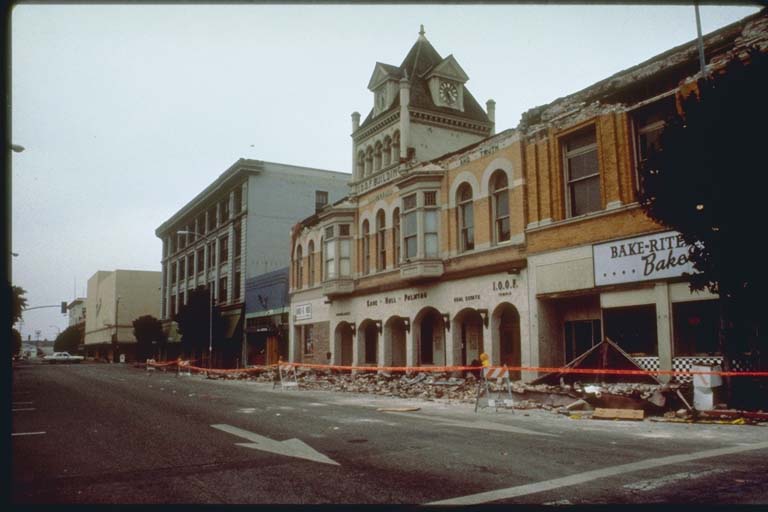
That night we slept in a tent.  The next day we traveled around Watsonville, seeing the devastation first hand -- houses burned down after gas leaks were ignited, houses that had jumped off their foundations, building facades that had crumbled, and a large crack in the downtown shopping center.  I saw porches that had collapsed and wondered what would have happened if we had been out tracting when the quake hit.  There was a long line at the grocery store as people lined up to buy bread and water.  Everywhere we heard rumors of another, bigger earthquake to hit sometime that day or night.

We went back to our apartment and had a barbeque lunch -- we were still without electricity.  Then we took a nap to catch up on lost sleep.  We were awoken by a knock on the door, it was our mission president, his wife and the A.P.s; they had come to check on us because we weren't home when they had called us on the phone.  They told us that church headquarters in Salt Lake City knew that all of the missionaries were safe, and that an announcement would be made on the news.

That night we decided to sleep in our apartment, but we were all experiencing a little fear and trepidation due to the rumors of a bigger quake.  As I prayed before going to bed, I thanked my Heavenly Father for my life, my safety and my shelter. I then explained my fears and anxieties about the rumors of another quake, and then asked for forgiveness for my weakness. I asked that he would help my lack of faith and then I asked if there would be another earthquake. I said that I knew there would be more aftershocks, but I wanted to know if there would be any more major earthquakes. The spirit gave me a sweet assurance there would be no more big quakes and I was blessed with peace.

There were more aftershocks that night; in fact, there seemed to be an aftershock every hour on the hour.  A particularly big aftershock at 2:00 a.m. woke me up.  My heart was beating fast, but I said to myself, “No, have faith. There can be no faith where there is fear. He promised that there would not be another big quake. Trust Him!”  A bigger aftershock around 3:00 a.m. woke us all up and we each ended up out in the living room. We listened to the radio for a few minutes.

By a quarter to 4:00, my companion, our district leader and his companion were asleep on the living room floor. I could not sleep and did some more reading by candlelight. By 4:30 a.m., I was also asleep on the living room floor. Thirty minutes later a big aftershock hit. Again I repeated, “No, trust Him.” That was the last aftershock of the night. The Lord kept his promise. By 8:00 a.m. then next morning we had electricity again. It felt like a turning point.  Later I wrote in my journal, "What an experience, though, to be able to go to a loving Heavenly Father and ask him if there would be any more big earthquakes, and then to receive an answer! What a confirmation of His love!"

I testify that Heavenly Father hears and answer prayers, and will give us peace when we need it, if we but ask Him in prayer.

Tomorrow I will write a little about what not to do regarding your parents after a major disaster.  I wrote about my fears; imagine how my parents must have felt. 


Thursday, May 16, 2013

The Whole Armor of God

"It is important that we make up our minds early in life as to what we will do and what we will not do" counseled President N. Eldon Tanner in the April 1979 General Conference. "Long before the moment of temptation comes we should have determined that we will resist that cigarette, that drink of whiskey, that act of immorality, or anything that will keep us from enjoying the companionship of the Spirit of the Lord. We all have different weaknesses and temptations, and we should examine our lives to find out what those weaknesses are and where we should put on extra armor so we can do what is right and not submit to temptation."

The talk can be found here:

http://www.lds.org/general-conference/1979/04/put-on-the-whole-armor-of-god?lang=Eng&clang=eng

It is my belief that when a member of the Quorum of the Twelve or of the First Presidency is speaking, past or present, we should be paying attention.

In October 1975, President Spencer W. Kimball addressed the General Relief Society meeting.  His talk contains counsel that can apply to all members, including missionaries.  "Temptations are great," said President Kimball. "Satan tells us that black is white. He lies to us; therefore, we must be prepared to make a bold stand before Satan, who is without flesh and blood, and against principalities and powers and the rulers of darkness. We need the whole armor of God that we may withstand. We must quench the fiery darts of the wicked with the shield of faith."

This talk can be found here:

http://www.lds.org/ensign/1976/03/the-blessings-and-responsibilities-of-womanhood?lang=eng

In the April 1974 General Conference, Elder L. Tom Perry spoke about how his parents clothed him each day.  "We were dressed in our home each morning, not only with hats and raincoats and boots to protect us from physical storm, but even more carefully our parents dressed us each day in the armor of God. As we would kneel in family prayer and listen to our father, a bearer of the priesthood, pour out his soul to the Lord for the protection of his family against the fiery darts of the wicked, one more layer was added to our shield of faith. While our shield was being made strong, theirs was always available, for they were available and we knew it."

That talk can be found here:

https://www.lds.org/general-conference/1974/04/build-your-shield-of-faith?lang=eng

In the October 1986 General Conference, President Gordon B. Hinckley quoted President Wilford Woodruff, who said, “There are two powers on the earth and in the midst of the inhabitants of the earth—the power of God and the power of the devil. In our history we have had some very peculiar experiences. When God has had a people on the earth, it matters not in what age, Lucifer, the son of the morning, and the millions of fallen spirits that were cast out of heaven, have warred against God, against Christ, against the work of God, and against the people of God. And they are not backward in doing it in our day and generation. Whenever the Lord set His hand to perform any work, those powers labored to overthrow it”

President Hinckley went on to say, "The victims who fall are as precious as those who have fallen in the past. It is an ongoing battle. . . . The war goes on. It is waged across the world over the issues of agency and compulsion. It is waged by an army of missionaries over the issues of truth and error. It is waged in our own lives, day in and day out, in our homes, in our work, in our school associations; it is waged over questions of love and respect, of loyalty and fidelity, of obedience and integrity. We are all involved in it -- men and boys, each of us."

President Hinckley's talk can be found here:

https://www.lds.org/general-conference/1986/10/the-war-we-are-winning?lang=eng

Excerpts from some of these talks were used in this video:


Missionaries, just like the rest of us need to put on the whole armor of God.


Tuesday, May 7, 2013

Finding People to Teach

No, this is not going to be a discussion on tracting, street contacting, or working with members to get referrals -- though I might point out that while converts can be found from tracting (I found two), referrals from members is the way to go as referrals lead to more converts than tracting.  Rather, this post is about finding people to teach mock discussions to, for those doing missionary prep as a DIY project, or whose prep program does not offer the opportunity.  Randy L. Bott, a former mission president, has this suggestion:

"Home teaching is the most often overlooked teaching opportunity.  At least once a month, young men have the opportunity to teach in a situation that parallels the missionary experience more closely than any other.  You and your companion visit a family to teach them the gospel of Jesus Christ.  Remarkable!  But what if your senior companion always teaches the lesson?  Well, why don't you shock him by volunteering to teach the next one?  If he is hesitant (which he won't be), remind him that you are trying to develop your teaching skills for your mission."

You might start off just teaching from the First Presidency message in the Ensign, but ask your companion if you can also teach one, two or even all of the discussions -- this will also give you experience in lesson planning.  "You would be light years ahead of other missionaries," writes Randy Bott, "if you could enter the MTC with the experience of teaching all [five] discussions.  You would know what questions to ask your MTC instructors, and you would know your strengths and weaknesses.  As you teach you will be more motivated to learn the scriptures and doctrines as you discuss sacred things with others."  Young women can have this same opportunity through Visiting teaching, though phone contacting is sometimes permitted if visits are hard to schedule.

Teaching mock discussions will have many benefits.  "Many missionaries," write Bott, "are shy and lack confidence in their ability to teach effectively.  These skills can be strengthened a great deal with a little experience.  Month after month you will see different reactions to different teaching styles.  You will need to adjust your style to meet people's needs rather then expecting others to accommodate your style.  Encourage them to ask questions so you will develop skills in answering.  The moment of truth is when you ask them to evaluate your teaching.  If they are honest, they will have some suggestions in areas where you might improve."

If you feel ready to teach more often than once a month, you might try talking to other families in your ward, at church or on the phone, and asking them if you could teach them a discussion.  This will give you some experience in contacting people and setting appointments.  "These people love you and want you to succeed," writes Bott.  Well, some of them might at least like your parents.  In any case,  "They will be much more patient than many investigators who haven't developed those feelings of closeness.  Try to change your weaknesses into strengths before you leave."

If you find the idea of teaching your home teaching families, or other families in the ward daunting, perhaps the best place to start is in your own home, during family home evening.  "It is difficult for Mom and Dad to always teach the lesson," writes Bott.  "What a pleasant surprise (more like shock!) if you volunteer to teach regularly.  If you start early enough, you will gain adequate experience in teaching almost all the gospel principles in a friendly setting before being thrust into a sometimes hostile environment.  Do yourself a favor and learn how to teach."

Another teaching opportunity you might seek would be to volunteer to teach a class at church.  Missionaries often have the opportunity to teach investigators who attend church in a gospel principles class during Sunday School.  Missionaries called to serve teaching in a foreign language sometimes teach English classes.  There are still other opportunities for teaching such as "at youth conferences, firesides, and discussion groups."

"Although you may feel afraid or anxious about teaching others," writes Bott, "you should realize that you have something worthwhile to say.  Choose a topic relevant to the audience you are addressing.  Try to get them involved by asking and answering questions and making observations.  You will soon discover how difficult it is to carry the entire load yourself.  When everyone is involved, teaching becomes enjoyable.  Don't ever turn down an opportunity to speak, because preparation forces us to learn.  Also, the challenge of teaching allows us to grow."


Source: Bott, R. L. (1995). Prepare with Honor: Helps for Future Missionaries. Salt Lake City: Deseret Book.

Monday, April 29, 2013

"It is Not Requisite that a Man Should Run Faster than He has Strength"

We live in a culture that often pushes people to do things quickly; "Hurry up and get married," or "Hurry up and have lots of kids."  And now, with the recent change in missionaries ages, there may be some who are saying "Hurry up and go on a mission."  I read last week about a young man who was about to leave on his mission, his farewell was scheduled for this Sunday.  Instead of a farewell, however, his family had to prepare for a funeral.  Apparently the pressure of going on a mission was too great, for this young man took his own life.  A family that was preparing to say goodbye, will never see their son or brother come home.

One of the reasons I started this blog is my belief that too often we do a lousy job of preparing young men and women to serve missions.  Too many missionaries quit and go home early because they were not prepared to handle the rigors of a mission.  Too many missionaries quit but stay in the field, wasting their time and their parents' money.

I had a companion tell me that he wrote to a friend back home that if he didn't like the MTC that he should go home because it wasn't going to get any better.  I wrote to some friends that "It gets better or worse depending completely on your attitude."  While that is true, our attitude may be determined by how adequately prepared we are when we enter the MTC.  As the saying goes, "Those who fail to plan, plan to fail."  If we fail to prepare adequately, we may only be prepared to fail.

Missionaries should go into a mission with their eyes wide open.  Serving a mission is difficult; it may be one of the hardest things you ever do, but it may also be the best thing you ever do.  The work is often hard, and sometimes seemingly unrewarding.  There will be some missionaries, including some companions, who will be difficult to get along with.  There will be days or weeks when you will feel that you are being stretched to the limit.  If you have the right attitude, it will all be worth it as the rewards for the faithful servant are many.

"And if it so be that you should labor all your days in crying repentance unto this people, and bring, save it be one soul unto me, how great shall be your joy with him in the kingdom of my Father! And now, if your joy will be great with one soul that you have brought unto me into the kingdom of my Father, how great will be your joy if you should bring many souls unto me!" (D&C 18:15-16)

I have called my mission the university of my life.  I learned more about life in those two short years than I have in all the years before or since.  I faced many trials and persevered.  I worked hard and when I was done I felt to say as Paul did that I had kept the faith and finished the race.  I look back now and recall as the best times those when we were working hard, even when we were having appointments cancel on us left and right.

The news about the change in missionary ages was wonderful, but don't feel like you have to hurry up and go.  Don't let anyone, even your parents, put too much pressure on you.  Parents, don't push your kids to leave before they are ready.

If the age for young men had been 18 when I graduated from high school, I could have left that summer, but I was not ready to do so.  I was attending an excellent missionary prep program, and during the month of August I felt that I could do nothing right when teaching mock discussions or role playing objections.  The adversary was working on me hard, trying to discourage me from going on a mission.

As we read in the Book of Mormon, there is opposition in all things; you can expect some opposition as you prepare to serve.  you certainly don't need the people around you, at home or at church, to put even more pressure on you.  In the end, this is between you and your Father in Heaven, and if you can be satisfied that you are working hard as you prepare, at your own pace -- within reason -- then you can tune out the voices that are telling you to hurry.  You can also tell the adversary to "Get thee hence."

It is important to remember that while they changed the ages for missionaries so that some can leave sooner, young men can still leave as late as when they are 25 -- there is no limit for young women.  So, as long as you are not dawdling or otherwise wasting time, you can be assured that you have plenty of time to prepare to serve.  If you're not ready at 18, that's okay, maybe next year, or the one after.  But be careful that you don't wait too long.

There was an elder in my mission who prepared to serve at 19, he put his papers in and received his call -- to the California San Jose Mission.  But he balked; as a small town kid he felt that he could not handle serving in a big city.  He asked to be released from his calling at that time, and this was granted.  Then, at age 25, staring the age limit in the face, he put his papers in again, and was called to . . . the California San Jose Mission.  He might have been a little nervous, still, at the idea of serving in a big city, but he answered the call and served his two years faithfully and well.

As King Benjamin said, we do not need to run faster than we have strength, but we should not take a casual approach either -- we should at least be running. Remember the tortoise and the hare, "Slow and steady wins the race."

 We should always ask if we can do more, and then we should stretch ourselves to do it.  We may not reach the goal, but we will have made the effort and gained from it, and maybe the next time we will reach the goal.  If we continue to fall short we should humble ourselves before our Heavenly Father, and exercise faith in Jesus Christ, then might we be lifted up to do more than we thought we could, because His grace is sufficient to make weak things become strong.

Thursday, April 25, 2013

We Learn to Teach "By Study and Also By Faith"

I wrote yesterday that the time to prepare to serve a mission is not the day you enter the Missionary Training Center.  I think this is more significant for those who are not learning a foreign language because their time in the MTC has been shortened from three weeks to two.  But even those learning a language, most of their time in the MTC will be spent on that effort.

I had the opportunity to attend a missionary prep program in my stake during the eight months preceding my mission.  At two meetings a week we were taught by returned missionaries, and once a week we could teach mock discussions.  I had many opportunities to teach the first discussion, and a few other opportunities to teach the second.  As I recall, we covered the first two discussions in the MTC.

During my first two months in the mission field I had to pass off each of the six discussions to my district leader, meaning I taught him in mock discussions each of the six.  Outside of making some visual aids for the plan of salvation portion of the fourth discussion in missionary prep, I learned the third through six discussions primarily during those first two months.

Having mastered the first two discussions before my mission, learning the remaining discussions did not prove to be very difficult.  Having taught mock discussions to members, teaching my district leaders was easy.  Teaching a real investigator for the first time was almost as easy.  The most difficult aspects of my time in the MTC and my first few months in the mission field turned out to be dealing with difficult companions, overcoming a lack of certain social skills, and dealing with an extremely slow area.

The discussions from my era were relatively easy, certainly compared to what missionary are asked to do now.  There was a time when the discussions were tightly scripted, the missionaries had to read the presentation word for word, and they were even directed at certain points to "look up and smile."  New discussions were introduced by the time I was preparing to serve that allowed the missionaries a significant amount of flexibility.  As long as we covered the principles of the discussion we could put them in our own words and even expand on them, within reason.  Of course, we could also just repeat the principles word for word if we chose (a pretty good portrayal of the first discussion in my era can be found in the move The Best Two Years).  It's a whole new ball game for today's missionaries.


Looking through Preach My Gospel one soon realizes that missionaries today are being asked to study certain principles and then make lesson plans to teach them.  The book gives overviews of principles to be taught, and then leaves the missionaries to plan how they will teach them.  However, the missionaries are not completely left on their own as a few example plans are provided.  There does not appear to be an option of just repeating principles word for word.  Another way of putting it is that missionaries today are not so much learning discussions as studying and learning the gospel and figuring out how they will teach it.

Hopefully you have been paying attention and doing the daily scriptural reading during those four years of seminary.  If not, now is the time to get serious and really read, study, pray and ponder.  For scripture study I would start with the Book of Mormon, then add the New Testament as familiarity with those texts will be the most helpful.  Read and study Preach My Gospel and the Missionary Preparation Student Manual, and find someone to teach at least the first two lessons to in mock discussions -- that, of course, would require some attempt at lesson planning.


I've never had to make a lesson plan, but I have prepared several talks for church meetings and there are some similarities to lesson planning and preparing a talk.  About a year ago I was asked to speak in Sacrament Meeting on Easter Sunday, and I only had a week to prepare. I started the week with prayer and scripture study and then later started writing my talk, giving me a couple of days to practice and revise. I thought about what principles I might discuss, some personal experiences, and looked for some quotes I might use.

Lesson planning, like preparing a talk, is a way of organizing our thoughts and information in a clear and brief manner -- brevity is a virtue in public speaking, less often really is more.  Begin with a single idea or topic and finding supporting information.  An organized lesson plan can help us in identifying principles that we may have overlooked.  A lesson plan can be as simple as writing a topic and listing under it a few related items, or it can be more complex as a collection of related information divided into several subcategories.  Another way to develop a lesson plan is to start with some general questions to answer or categories of information to look for whenever we study a doctrine.

Before you can teach God's word, you must first learn His word.  We learn to teach "by study and also by faith" (D&C 88:118).


Wednesday, April 24, 2013

Are You Ready?

Here are a few stats showing how the change in missionary ages has impacted the work:

Before the change the age limit for sisters was 21 and 19 for elders, now the limit is 19 for sisters and 18 for elders (if they have graduated from high school).

Before the change, approximately 15% of missionaries in the field were sisters.  Now approximately 50% of missionaries in the field are sisters.

Before the change the maximum number of missionaries per mission was 170, now the maximum number is 250.

Before the change, missionaries not learning a foreign language spent three weeks in the MTC, now they spend two weeks.

Before the change the number of weekly missionary applications was around 700.  That number jumped to 4,000 immediately following the announcement.  There has been a 471% increase in the number applications since the announcement.

There are 347 missions around the world.  58 new missions were created to accommodate the influx of new missionaries resulting from the change.  52 languages are taught at the Prove, Utah MTC.  There are 15 Missionary Training Centers worldwide.  The Provo MTC can accomodate 4,800 missionaries.

The largest mission, with a population of 1 billion, is the India Bangalore Mission.  The smallest mission, of just 10 acres, is the Salt Lake Temple Square Mission.

There are 65,634 full time missionaries, 20,000 more have received their call, and 6,000 more are in the interview process.

"The response of our young people has been remarkable and inspiring," said President Thomas S. Monson.

There is no question that this is exciting.  As a recent U.S. Navy recruiting ad put it, "Let the journey begin."  The great adventure awaits.

But let's pause a moment and ask an important question: Are you ready?

Have you done all that you could to prepare?

Are you familiar with the discussions you will be teaching?  Are you familiar with the scriptures?  Can you make a lesson plan?  Can you teach?

Are you physically prepared for the rigors of missionary works, riding bikes and walking all day long?

Are you spiritually prepared to give the work everything you have, everyday, every moment, all the way?

The time to start preparing to serve is not the day you arrive in the MTC, especially now that missionaries not learning a foreign language will only be in the MTC for two weeks instead of three.

The time to start preparing is not the day you arrive in the mission field, or the morning you first wake up in your first area.

The time to start preparing is now.  How much time do you have before you enter the MTC?  What can you do in that amount of time?  Plan your work and work your plan.

God speed.


Tuesday, April 23, 2013

"The Lord Looketh Upon the Heart"

Two missionaries approached Al Fox on the street in Rochester, New York, and asked her if she wanted to know more about Jesus Christ. "No," she answered, but there was something about these two young men so she gave them an unusual challenge.  "If you bring me a steak dinner," she said, "I'll listen to your message."  Al Fox, now known as "the Tattooed Mormon," thought religion was a rather silly thing when she ran into those elders, and she thought asking them to bring her a steak dinner would get rid of them.

I can only imagine what those elders thought.  "A steak dinner?! Hey, I'm on a budget."  But I can also imagine the spiritual prompting they received, "Do it!" So they did, that very same day, and as a result Al's life would change in ways she could never have imagined. That doesn't mean, however, that teaching Al Fox would be easy.  On the one hand, Al just loved the way she felt around the elders, on the other hand, "Every day I saw them, I did everything I could to do anything except talk about the Church, and I thought I was doing fairly well."

Then one day the missionaries showed her the video "The Restoration" which depicted Joseph Smith's First Vision.  Al's reaction was to think that there was no way that happened, so she issued another challenge to the elders, "I want to go there," she said.  What she didn't know was that Palmyra was only about a half hour away from Rochester.  In the Sacred Grove, Al Fox learned that Heavenly Father is real and that He does answer prayers, as she herself knelt and prayed for the first time -- She felt so awkward that she repeated after the elders. "But that's how it began," she would say later, "because I started to care, because of that prayer."

But Al Fox was still a "rascal" as an investigator.  While she began to open up, and started reading the scriptures and praying, she was still hoping to prove that the LDS Church was wrong.  Yet even as she fought it, the change in her heart grew.  Then one day she decided to be baptized, "But it came out of nowhere," she said.

The missionaries got a call at 4 a.m. from Al who shouted at them "I want to get baptized!" before just as suddenly hanging up the phone -- her declaration had shocked her.  Fortunately, the elders called her back.  Despite her shock and her fears, Al decided to follow through. "I knew when I said it, I felt it, and that was what I needed to do."

One month after challenging the elders to bring her a steak dinner, Al Fox was baptized. "I was just filled with this excitement and this happiness that I couldn't even put it into words," she would later say, "and I wanted to yell to all of New York that happiness is real, that it exists, and that they can have it.  I was so excited that I told everyone. I made a promise that how I felt that day when I got confirmed and I got baptized, I didn't want it to ever go away, because I recognize that it only came from the gospel, and I am going to do everything I can to keep that with me."

Like many converts to the church, Al found that members of her family, and many of her friends disapproved.  Some friends rejected her, but at the same time, as a newly confirmed Latter-day Saint, Al found that her new life was no longer compatible with the lifestyles of other friends.  One of her sisters, however, would join the church not long after Al, and would go on to be married in the temple (Al is still single, but she does have a boyfriend). At the same time, because of her many tattoos, Al had a hard time fitting in with the LDS community.

Excited about the Restored Gospel, Al considered serving a mission, but when she prayed about it she received an unexpected answer: move to Utah.  It was hard, she tried to fight it, but she moved to Utah. On her first day in the state she was at a restaurant, already feeling self-conscious, holding a copy of a biography of one of the presidents of the church, when a man tapped her on the shoulder and said, "You know, it's pretty ironic you look the way you do, holding that book."  Al would later say "My heart broke.  I just wanted so badly wanted to turn to him and say, 'Do you know what I just went through, and what I gave up, and how hard this is?'"

But Al recognized that she had a choice; she could blast the guy, or she could choose happiness. Instead of going off, Al turned to the man, shook his hand and smiled. "Hey, I'm Al Fox, and I just got baptized and this is like my first day here." Naturally, the man felt a little bit silly, and to try to make up for it, he bought her lunch.  About a year later Al would run into this man again; as it turns out, the man was a stake president, and he had been telling the story of this encounter in stake conferences, which was quite the coincidence because Al had been telling the story at firesides.

Al Fox has found several ways to share her happiness.  She started a blog, making and posting videos online and, of course, sharing her story at firesides -- something she would never have expected as she sluffed her college public speaking class.  Some missionaries have started using her videos and her blog to help their investigators -- in fact, this is how she met her boyfriend, who as a missionary found her on Facebook as he used it as a missionary tool; they met in person after he got home (I mention this because she keeps getting asked out by guys who meet her and hear her story).

"The happiness that I have felt is real," said Fox in a recent interview. "It's real, and I recognize that everyone doesn't have and feel this. And I want everyone to know that they can. Happiness is the gospel - it comes from there and it's real, and I'm grateful for that."


Sources:

Marsden, M. (2013). "Convert endures trial, shares happiness through social media (+video)." Deseret Morning News, February 7, 2013

Worthen, K. (2013). "Finding Joy in the Gospel: Converts Share Their Stories." LDS Living, March/April 2013.

Interview with Al Fox on The Cultural Hall accessed at http://www.youtube.com/user/22AlFox on April 23, 2013.

Al Fox's Blog: {In the Head of Al Fox} at blogspot. http://alfoxshead.blogspot.com/