Tuesday, April 22, 2014

Ours Not to Reason Why

I recently experienced a major life changing event, a diagnoses with type 1 Diabetes.  On the one hand, I wanted to know why this happened, but on the other I had to accept that this was the new reality.  This reminded me of other times in my life when I wondered "why?"  In this life, where we walk by faith, it is not given us to know all the answers, and seeking answers sometimes distracts us from doing the things we need to do.

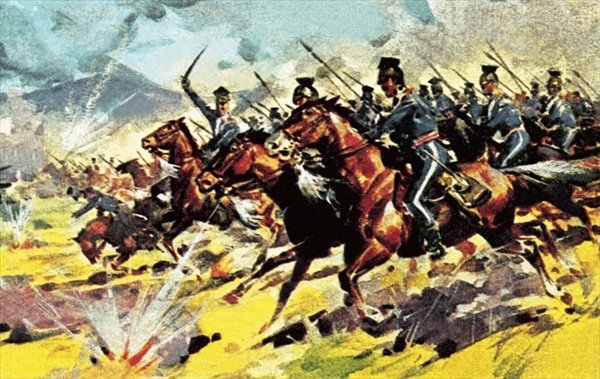
Consider the Charge of the Light Brigade, a poem by Alfred Lord Tenyson, which describes an event in the Crimean War:

“Forward, the Light Brigade!”
Was there a man dismayed?
Not though the soldier knew
Someone had blundered.

Someone had, indeed, for the charge had been ordered against the wrong hill, and the Light Brigade would ride into the enemy's guns.

Theirs not to make reply,
Theirs not to reason why,
Theirs but to do and die.
Into the valley of Death
Rode the six hundred.

Missionaries may wonder at the reasons for some mission rules.  Or they may wonder why an investigator who had seemed golden, and who was so close to baptism, may suddenly change their mind.  They may wonder why another pair of missonaries, who they see fooling around instead of working, are blessed with a baptism, when they themselves are not, despite their hard work.

Missionaries would do well to remember the words of Robert E. Lee, who commanded the Army of Northern Virginia of the Confederacy, during the American Civil War:

"Duty is the sublimest word in our language.  Do your duty in all things.  You cannot do more.  You should never do less."

Questions can lead to doubts, and doubts can lead to a loss of faith. President Dieter F. Uchtdorf addressed this during the October 2013 General Conference when he said, "There are few members of the Church who, at one time or another, have not wrestled with serious or sensitive questions. One of the purposes of the Church is to nurture and cultivate the seed of faith -- even in the sometimes sandy soil of doubt and uncertainty. Faith is to hope for things which are not seen but which are true."

He went on to say, "Therefore, my dear brothers and sisters -- my dear friends -- please, first doubt your doubts before you doubt your faith. We must never allow doubt to hold us prisoner and keep us from the divine love, peace, and gifts that come through faith in the Lord Jesus Christ."

I do not believe in blind faith, or in putting aside all questions to blindly follow the leaders of the church.  One of the fundamental principles of my faith is that, like the boy Joseph Smith, I can go to my Heavenly Father in prayer to ask about things I do not understand.  But I have also learned that, just as "no" can be an answer to prayer, that God will sometimes not give me the information that I think I need.  He knows what I do not, and He knows best what I need to know and what I do not.  His ways are not my ways.

Yesterday I thought I'd seen it all
I thought I'd climbed the highest wall
But now I see that learning never ends
And all I know to do is keep on walking
'Round the bend


Singing
Why, why, why
Does it go this way
Why, why, why
And all I can say is

Somewhere down the road
There'll be answers to the questions
Somewhere down the road
Though we cannot see it now

And somewhere down the road
You will find mighty arms reaching for you
And they will hold the answers
At the end of the road


Sources:

The Charge of the Light Brigade by Alfred Lord Tenyson, accessed at: http://www.poetryfoundation.org/poem/174586

Come, Join With Us by President Dieter F. Uchtdorf, October 2013, accessed at: https://www.lds.org/general-conference/2013/10/come-join-with-us?lang=eng

Somewhere Down the Road, lyrics by Amy Grant & Wayne Kirkpatric, accessed at: http://www.metrolyrics.com/somewhere-down-the-road-lyrics-faith-hill.html


Monday, April 21, 2014

The Life Ahead: On Coming and Going


You can be the captain
I will draw the chart
Sailing into destiny
Closer to the heart

A month or so ago I drove up to Wellsville, Utah for the homecoming of my nephew, who had just returned from the Bangkok Thailand mission.  As we were having refreshments at his house after the meeting, the bishop stopped by, claiming that he forgot to present my nephew with his missionary plaque.  It turned out, however, that this was a ruse, for the bishop produced an envelope for my niece from the missionary department.  My niece started to cry as she opened the envelope and read that she had been called to the Hong Kong mission.  The bishop had conspired with my niece to surprise her parents.

This prank was recorded and my niece posted the video on YouTube:


This experience of watching my nephew return and my niece receive her call, got me thinking about coming and going -- leaving on a mission and returning home.

When I returned home my father told me about something he saw on the day I left for the MTC in Provo.  He had stopped at the door to my room just as I was getting ready to leave.  He watched as I picked up a model airplane and looked at it for a few moments.  Then I put it down and walked out of the room.  I did not remember doing this, but I suppose that I was thinking about what I was leaving behind.

A few weeks later, after getting off the plane in San Jose, California, I read a poem that dealt with the idea of leaving things behind.  The poem begins with a missionary, while flying out, thinking of his family and friends and asking himself if he wanted the life ahead or the one he was leaving behind.  The poem then jumps two years ahead to this missionary's flight home.  Now he is thinking of his companions, his mission president, and the people he taught and baptized.  Once again he asks if he wants the life ahead or the one he is leaving behind.

For me, leaving on a mission was like starting out on a great adventure.  I knew what I was leaving behind, but I could not wait to "let the journey begin."  The only hard moment I had was after boarding the plane to fly out, for it was then that it hit me that I would not see my family and friends for two years, and I had a hard time holding back the tears.

I found coming home to be much more difficult.  I loved my mission and I did not want to leave it.  Had they asked me to stay for another six months I would have leaped at the chance.  I first asked my mission president for an extension when I had been out only nine or ten months.  At the same time, the last few months were difficult as I often felt that I was being pulled in two different directions.  The end of my mission was fast approaching, and I was looking for the brake pedal.  Yet at the same time, I had thoughts of home, of seeing family and friends again.

One of the fundamental facts of life is that time marches on; we can neither stop it, nor slow it down.  The only thing we can do is make the most of every moment.  You may not realize it, on that hot day, as you tract that long street, that the time will come when you will miss doing this very thing, when you would give almost anything to do it again.  The times I look back on now with nostalgia were those times when my companions and I were working hard, even as appointments canceled on us left and right.

Returning home meant another new beginning, the start of the next adventure.  It meant finding a job and picking a college to attend.  It meant entering the dating scene and looking for the girl I would marry.

I can remember the day I flew home, how I looked out the window and watched the Monterey Peninsula recede into the distance -- Monterey, where I had my first two baptisms, and where my companion and I worked so hard, yet experienced so much adversity as so many appointments stood us up.  The next thing I knew I was looking out the window at the snow covered Wasatch mountains.

After the plane landed, I waited with another missionary until we were the last to get off.  We paused to shake hands and then turned to find our families in the terminal.  I hugged my famiy and said hello, they took me to lunch, and then home where I opened a few Christmas presents, even though it was mid Jaunary.  And then, for the first time in two years, I was alone.  Instead of thinking about what streets in Watsonville my companion and I were going to tract the next day, I had to think of other things to do.  I am sure I started reading my first non-church related book in two years.

But there was one last challenge from my mission to face: my homecoming meeting.  I looked forward to seeing my friends, and I wanted them to see how I had changed, but only one friend was able to attend.  I had my talk all prepared, and I had a lot to say, but the two youth speakers and the ward choir took the first 25 minutes, leaving me but 13.  I thought about getting up, bearing a short testimony and sitting down, but it occured to me that this was the only homecoming meeting I was going to get.  So I started praying for inspiration and, as a result, I probably gave the best talk I have ever given -- going 4 minutes over time.

Some return missionaries may be surprised to find that
there is still much to learn, that there is still a strait and narrow path to walk and much more yet to be endured.  There will be challenges in college, at work, in marriage, and in other endeavors in life.

No matter how much adversity one has experienced, or how much one has learned, they are still human and will continue to fall short of perfection because of their weaknesses and inadequacies.  The good news is that the Atonement is there for them, even if their failings are not great sins.  There will always be the the opportunity to humble ourselves and have faith in Christ and to be lifted by His grace.

"Wherefore, ye must press forward with a steadfastness in Christ, having a perfect brightness of hope, and a love of God and of all men. Wherefore, if ye shall press forward, feasting upon the word of Christ, and endure to the end, behold, thus saith the Father: Ye shall have eternal life" (2 Nephi 31:20).


Wednesday, January 8, 2014

The First Baptism

Just after I transferred into my second area, in Seaside, California, we started teaching a woman named Trudy.  Actually, we were teaching her the discussions for the second time.  For whatever reason, it was decided that this was necessary, and so I participated in teaching her all six discussions.  I thought that this lady had to be golden because she had an LDS bumper sticker on her car.

After we had re-taught Trudy the first discussion she had a stroke.  It seems that she was under so much stress from family issues that she had a few minor strokes.  The latest one landed her in the hospital, and after a few attempts we were able to teach her the second discussion while she was there.  While in the hospital, Trudy made three commitments with God, one of which was to be baptized.


When she got out of the hospital we taught her the third and fourth discussions at one appointment, and then my companion got transferred.  With my new companion, I taught her the fifth and six discussions a few days before her scheduled baptism.  After teaching the third and fourth discussions, I wrote the following in my journal: "This truly is a spectator sport. It is the spirit that converts and it is awesome to be here to see it happen. How did I get so lucky?"

Trudy wanted my former companion and another elder to come back down for the ceremony and to baptize her.  We called the mission office but could not get permission for them to come, so I was elected to do the honors.

About this time the water heater to the font in the stake center died.  We went to the chapel two hours before the ceremony and started filling buckets full of hot water in the kitchen and dumping them in the font but we eventually ran out of hot water.  We had to finish filling the font with cold water.

Just before the ceremony, of course, we took some pictures outside of the both of us in our whites along with my companion in his suite.  After the talk on baptism, Trudy and I walked to the font.  On the way I told her to bend her knees because she was going down into the water backwards.  “Backwards?!” she said.  Ok, maybe that was not the best time to tell her.  We had stopped by her place the night before to go over the ceremony but neglected that rather important detail.

When I led Trudy into the water she let out a shriek because it was so cold.  Everybody laughed and she said it reminded her of growing up in Canada.  We got into position and I said the prayer.  I then started taking her back to immerse her in the water; she was most of the way under when her left leg popped up.  I started to bring her back up and almost lost her.  Trudy was, well, a bit overweight, add the wet clothes from being immersed, and she was very heavy.  I think I let go of her, but she was back up enough that it wasn’t much of a problem.
 

My companion, one of the witnesses, told me that we had to do it again because her leg popped up.  Trudy was having some trouble catching her breath because she was very cold.  We had to calm her down before we could continue.  I went through the prayer again, and then started taking her back down into the water.  This time she stayed completely under before I started bringing her back up.

I got her most of the way out of the water when I let go and dropped her.  She was heavier than I had the strength to lift -- I think that I have written before about being so skinny growing up that I was sometimes called the Six Million Dollar Weakling.  In any case, this time Trudy went reeling back to the stairwell where she hit her head on the railing.  We finally got her up on her feet and we both went back to the dressing rooms to change.

I felt so bad that after, I changed into my suite, I just sat in the dressing room with what must have been a thousand yard stare.  I sat there for a long time until my companion and our district leader came back to check on me.  They assured me that everything would be okay.  My companion confirmed Trudy and the service concluded with a hymn and a prayer.  I still felt bad.  A baptism is supposed to be a beautiful thing, but this one seemed more like a disaster.


Even before the ceremony I had been having mixed feelings about this baptism.  I felt less than worthy of the blessing of a baptism as my first companion in Seaside often decided to visit the home of a member family where we would often end up watching television -- a definite no-no.  Then, as noted above, when I taught Trudy it was the second time that she was taught the discussions.  I was not there to see her conversion.  It did not help when she asked for two other missionaries to come down and baptize her.  After the ceremony I felt even worse.

I have wondered for many years what we could have done differently at Trudy’s baptism.  It would have been really helpful to me if there had been another person in the font to help me pull Trudy back up out of the water.  I do not know if that is allowed, however.  Perhaps we could have let Trudy kneel down in the font, but I do not know if that is allowed either.  I honestly thought I was going to get sued, but it seems that everything really did turn out alright.

Later in the evening we stopped by to see Trudy and give her a priesthood blessing.


A few days after this, I got a letter from my older brother.  Apparently the last letter I wrote home had left him irritated.  His letter provided the proverbial slap in the face that I needed.  I used to think that my challenges were harder and more frequent that every one else’s.  My brother wrote that I was unique, but not because of my challenges.  This opened my eyes and I started noticing some of the trials those around me were experiencing.  I now realized that every one else’s challenges were just as hard and in a lot of cases similar to mine.

I should have been grateful to just to have been involved in the baptism of Trudy.  It is the spirit that converts, not us, so what does it matter if her conversion happened before I got there?  For whatever reason, it was decided that she should be taught the discussions a second time, and I was here for that.


Then there was my second companion in Seaside, who showed up in time for the last two discussions and the baptism itself.  He did not appear to be bothered by the fact that he did not get there sooner.  Trudy still needed some help after the baptism with some issues and my companion helped her in a lot of ways, so maybe he earned it a little after the fact.

Tuesday, December 24, 2013

First Chrismas (In the Mission Field)

Each Christmas Eve the California San Jose Mission had a mission wide Christmas Conference -- every missionary in the mission gathered at Cherry Chapel, the LDS meetinghouse on Cherry Avenue in San Jose.  Each zone would perform a skit or a musical number.  The Christmas Conference in 1988, when I had been out about a year, was my first.

My zone sang Far, Far Away on Judea’s Plains and I Stand All Amazed in Spanish.  The zone leaders of the Eastside San Jose Zone were Span Ams (Spanish speaking elders) and according to at least one of them, I Stand All Amazed is tons better in Spanish.

After each the performances of each zone, we broke for lunch.  My trainer, and an elder who was with us in my first apartment, came and sat with me and my current companion.  My trainer and I had not gotten along very well when we were together, but a few weeks before Christmas he sent me a card in which he thanked me for what he learned from our time together.  That Christmas Eve at lunch we had a nice conversation; I couldn't get over how friendly he was being.  Meanwhile, as part of reaching for a goal I had set to become more outgoing, I tried to take advantage of the opportunity to make conversation.

After lunch we had a surprise speaker, President Howard W. Hunter, who had some family in the area.  President Hunter had an informal, friendly chat with us about some of the neat things that are going on in the church.  For example, while the church did not have official recognition in Myanmar (formerly known as Burma), some citizens in that country had found a priesthood leadership manuel and some other church materials and wanted to organize a branch inside the country.  Because the church was not recognized by the government, they could not baptize these people or organize a branch, but the church was looking for ways to help these individuals without breaking they laws of Myanmar.

After his remarks, those of us who wished to lined up to shake his hand.  When I shook his hand I had the feeling that he would be the next president of the church.  At the time, President Hunter was in a wheelchair due to some health issues he was experiencing; at recent General Conferences he gave his addresses while sitting down.  Some of my fellow missionaries were not sure when I told them of the impression I had recieved.  Nonetheless, a few years after I came home from my mission, President Hunter did become president of the church.  While he was the president only a short time, his example and teachings were endearing to many.  President Hunter would pass away not long after the dedication of a temple in my hometown, Bountiful, Utah.

The Christmas Conference was an opportunity to talk to missionaries I had not seen in awhile, from old companions and apartment mates, to some elders who were with me in the MTC.  After the conference, my companion and I went to a dinner appointment with a family in the ward we were assigned to.  After dinner we play Pictionary with the two older daughters who slaughtered us . . . seriously, it was not pretty.

The next morning, Sunday and Christmas Day, we went a combined Sacrament Meeting for three wards.  After the meeting we stopped by the home of the ward mission leader and watched his family open their presents; they found a few candy bars to give to us as presents.  Then it was off to lunch with another member family.  After eating we played another game, Whatzit, where you try to guess names or phrases from jumbled up images.  I had a difficult time with this game because it helps to talk it out as you try to guess, and I'm just not that verbal.  Otherwise, a fun time was had by all.  After dinner that night, with yet another member family, we stopped by the bishop's home on our way back to our apartment.

All in all, it was a good Christmas.


Sunday, December 8, 2013

How Deep is Our Commitment to the Gospel?

In the Book of Mormon we read about a dream which was had by the prophet Lehi, in which he partook of the fruit of the tree which represented the love of God.  In his dream, Lehi saw "numberless concourses of people" following the path to the tree only to wander off and lose their way when a mist of darkness arose.  A second group of people was more fortunate as there was a rod of iron next to the path, which the people did cling to as they pressed forward through the darkness.  These people were able to reach the tree and partake of the fruit, but then things went wrong for them; "they did cast their eyes about as if they were ashamed."  Why did they do this?

In his dream, Lehi saw a "great and spacious building" in which there were people who "were in the attitude of mocking and pointing their fingers towards those who had come . . . and were partaking of the fruit."  The people of the second group then "fell away into forbidden paths and were lost."  They had partaken of the fruit, "which was most desirable of all other fruit", yet they were unable, or unwilling, to "endure to the end."

Lehi then saw a third group which not only reached the tree successfully, but which also did not fall away after partaking of the fruit.  These people had pressed "forward, continually holding fast to the rod of iron, until they came forth and fell down and partook of the fruit of the tree."  Elder Kevin S. Hamilton of the Seventy said in the October 2013 General Conference of the LDS Church that "The rod of iron represented for this group of people the only safety and security that they could find, and they held fast continually; they refused to let go, even for something as simple as a Sunday afternoon ride in the country."

Elder Hamilton then quoted Elder David A. Bednar of the Quorum of the Twelve in regard to this third group: "The key phrase in this verse is 'continually holding fast' to the rod of iron. . . .  Perhaps this third group of people consistently read and studied and searched the words of Christ. . . .  This is the group you and I should strive to join."

In the history of the Church of Jesus Christ of Latter-day Saints, we can find stories similar to the experiences of the second and third groups in Lehi's dream.  Some such stories occurred during the Kirtland period of the church where the saints experienced difficulties in building up the Kingdom of God and then enjoyed the Pentecostal experience at the dedication of the Kirtland temple, only to have some then wander off in forbidden paths.  Others went through the same experiences, but remained faithful through the trials that followed in Missouri and Illinois.

I have written before about my great great great grandfather Frederick G. Williams, who joined the church in Kirtland, Ohio, and traveled with Oliver Cowdery, Peter Whitmer Jr., Parley P. Pratt and Ziba Peterson on their mission to the native Americans living in the Indian territories (http://thewholemissionary.blogspot.com/2012/11/the-mission-to-lamanites-and-conversion.html).  Williams was later called to be the second counselor in the First Presidency, he donated land to the church for the construction of buildings to further the work of kingdom, and he saw an angel at the dedication of the Kirtland temple -- the angel was also identified as the Savior.  But there were also trials; there were disagreements regarding his role as a justice of the peace, an argument with the prophet Joseph Smith regarding business affairs of the Kirtland Safety Society, and his daughter married a man who would be less than faithful to the church.

Despite the trials, it could be said that President Williams had success, prominence and spritual fulfillment in Kirtland.  When he left Kirtland, he would lose almost everything.  At a conference in Missouri, members refused to sustain him as second counselor in the First Presidency and he lost this position.  An invalid son, whose healing had been promised if he and his wife remained faithful, passed away.  His son-in-law became involved with other members turning against the church and collaborating with its enemies. Finally, Williams would be excommunicated from the church as the saints departed for Illinois.

A descendant of Frederick G Williams would speculate that he suffered guilt by association as he tried to mediate with his son-in-law and others who were turning against the church, trying to persuade them to return to the fold.  Additionally, Williams was absent when the saints were making the trek to Illinois, and many who were absent at that time were excommunicated.  Williams may, however, have been absent because of his work in settling an estate belonging to a member of the church, for which he spent three days in court in Far West in March 1839.  The business of settling the estate allowed Williams to visit Joseph Smith who was then in Liberty Jail.  In later years, Brigham Young appeared to admit a mistake had been made when he would teasingly ask Frederick's wife Rebecca if she had forgiven him yet.

It is certainly possible that Williams had committed an offense worthy of being excommunicated, but no documentation can be found regarding what that offense might have been.  Even so, when Joseph Smith arrived in Illinois, he counseled Frederick G. Williams to submit himself before the church and ask for forgiveness.  Williams did so in April 1840, and was received back into the fellowship of the church.  There may have been some hard feelings, however, as Dr. Williams chose to set up his practice in the town of Quincy, rather than in Nauvoo.  Still, Williams remained faithful until his death in October 1842, at the age of fifty-four.

Frederick's wife, Rebecca, and his son, Ezra, would cross the plains to settle in the valley of the Great Salt Lake.  Ezra Williams would establish the first hospital west of the Mississipi in 1852, when the Williamses converted their spacious two-story, seven room adobe home, which stood at 44 East North Temple in Salt Lake City.

Despite everything he had lost, despite the difficulties he had experienced, Frederick G. Williams remained faithful to the end.  Whatever disagreements he may have had, even emotional scars, what mattered to him was that Joseph Smith was a prophet of God and that the Book of Mormon was the word of God.  His commitment to the gospel was deep enough that he died full in the faith.

Will we be able to say the same thing?  We live in a world, it seems, where personal attacks are okay, but standing up for your beliefs is not.  In the church, "he said/she said" disagreements or other actions by imperfect people drive others from the church because they are offended.  Others, despite such wounds, choose to remain faithful, to continue holding fast to the rod of iron.  What will we do?  How deep is our commitment?


Sources:

Williams, F. G. (2012). The Life of Dr. Frederick G. Williams: Counselor to the Prophet Joseph Smith. Provo, Utah: BYU Studies.

Hamilton, K. S. (2013). "Continually Holding Fast. Ensign, vol. 43 (11).
http://www.lds.org/general-conference/2013/10/continually-holding-fast

Sunday, December 1, 2013

Not For Sale

"What is it that gentlemen wish? What would they have? Is life so dear, or peace so sweet, as to be purchased at the price of chains and slavery? Forbid it, Almighty God! I know not what course others may take; but as for me, give me liberty or give me death!"

This was the rousing finish to the now famous speech given by Patrick Henry in St. John's Church, Richmond, Virginia, on March 23, 1775.  Henry was speaking to men who hoped to avoid war between the colonies and Great Britain.  "Gentlemen may cry, Peace, Peace, but there is no peace," Henry declared. "The war is actually begun! The next gale that sweeps from the north will bring to our ears the clash of resounding arms!"  He was very nearly right, for in less than 30 days the "shot heard round the world" was fired at Lexington in Massachusetts.

A few thousand years ealier, a prophet of God explained that we have the ability to choose between liberty and death:

"Wherefore, men are free according to the flesh; and all things are given them which are expedient unto man.  And they are free to choose liberty and eternal life, through the great mediator of all men, or to choose captivity and death, according to the captivity and power of the devil; for he seeketh that all men might be miserable like unto himself" (2 Nephi 2:27).

Few, if any, would consciously choose captivity and death, but we often face choices that could lead us into captivity.  We may even think we are choosing liberty, when in fact we are choosing the opposite.  Another prophet has warned us that we may be flattered or lulled into choosing captivity instead of liberty.

"For behold, at that day shall he rage in the hearts of men, and stir them up to anger against that which is good.  And others will he pacify, and lull them away into carnal security, that they will say: All is well in Zion; yea, Zion prospereth, all is well -- and thus the devil cheateth their souls, and leadeth them away carefully down to hell.  And behold, others he flattereth away, and telleth them there is no hell; and he saith unto them: I am no devil, for there is none -- and thus he whispereth in their ears, until he grasps them with his awful chains, from whence there is no deliverance" (2 Nephi 28:20-22).

Patrick Henry's words may echo, "Is life so dear, or peace so sweet, as to be purchased at the price of chains and slavery?"  Is anything we may find desirable worth such a price?

For McKay Christensen, the answer was no.  Mckay expected to attend college, serve a mission, and work for his family's business, but all that changed during his senior year.  On the baseball diamond he found unexpected success, batting .500 and stealing 62 bases in 62 attempts.  He was named to the all-American team and was rated among the three or four best athletes in the baseball draft.

When Mckay told the scouts that he wanted to serve an LDS mission, they told him that he would be among the first few players chosen in the draft and at least one team then offered him a million dollar signing bonus to skip his mission.  McKay Christensen answered by saying "My mission is not for sale."  Most major league teams turned their attention elsewhere, but the California Angels took Mckay with the sixth pick and offered him a two year break in which to serve his mission.

While he was serving his mission in Japan, the Angels traded Mckay.  After returning home, the once hot prospect would play for three different major league teams over four seasons.  As the Lord said in 1 Samuel 2:30, "for them that honor me I will honor."

Most of us will not have an opportunity as great as playing a major league sport.  But there will be other challenges and temptations.  Some may have a hard time leaving their girl behind to serve a mission.  Others may settle for a less than honorable person in order to avoid a life of loneliness.  We would do well to remember what Patrick Henry and McKay Christensen said about the choices they faced.


Sources:

http://www.deseretnews.com/article/600159905/Closer-to-home-Christensen-hangs-up-cleats-joins-family-business.html?pg=all

http://www.history.org/almanack/life/politics/giveme.cfm


Friday, November 15, 2013

"Let George Do It"

In the Spencer W. Kimball talk I linked to in yesterday's post, Elder Kimball said that at some point missionaries need to speak up when they see other missionaries breaking the rules.  "This is not the program," or, "This is my mission, too."  There was a time early in my mission when I wish that I had spoken up.

One of the rules of my mission prohibited exercising with free weights, which, it turns out, quite a few missionaries wanted to do.  One elder, who hoped to play football at BYU after his mission, wrote to then-head coach Lavell Edwards and asked for a letter that he could show the mission president on the importance of weight training.  Coach Edwards wrote back to say that the elder should obey all mssion rules, including the one against the use of free weights.  I don't know why my mission president instituted this rule when he took over the mission, but, then, I didn't have to know.

While I was still in my first area, at least two of my apartment mates were among those elders who didn't like the weightlifting rule.  A member, who lived close to our apartment, had a home gym and invited us to use it whenever we wanted.  One night, the other three elders decided that they were going to start going to this home gym every night after our 9:30 check in call.

They also decided that I would be the one to make the phone call to the zone leaders to report that we were in for the night – one of our zone leaders was also acting as our district leader at this time.  There is a tradition in the U.S. Navy of having the most junior officer in the wardroom do the menial, even dirty, tasks.  The other officers will say “Let George do it,” George being the nickname for the junior officer.  Well, in this case at least, I was George.

So, I made the call and then we all went over to the member’s home gym.  I went only because I could not be at the apartment alone -- well, maybe I could have, except that my older RM brother had advised me just before I got on the airplace to never leave my companion.  Unbeknownst to us, while we were out the zone leaders had called back, and when we got back to the apartment they were there waiting for us.  While I believed I was in a position where I had had little choice, I still had to admit to the zone leaders that I had lied.


Did I have a choice?  Well, of coure, we always have a choice.  My problem was that for several reasons I didn't have much confidence.  I was allowing myself to feel intimidated by other elders just because they had been out longer than I had been.  I'd had a rough time with my MTC companion, and when I got to my first area was in a mood to be more cautious, so I became even more introverted, which caused problems with my trainer.  When my third companion and our two flat mates wanted to go to the home gym after we were supposed to be in for the night, I believed there was nothing I could do to stop them.

Not long after this I had a conversation with one of my zone leaders, I think he knew that things haden’t been going too great for me. I told him how I felt, that I was discouraged and had a confidence problem. I said that I had come into the mission field with an inferiority complex because I had grown up with heavy persecution in school, in the neighborhood, and even at home. I said that I didn’t know who I was.  My zone leader told me that he, too, had faced a lot of persecution, and that everyone comes out not knowing who they are. He said the best thing I could do is share my feelings with others, particularly my companion. He said that I would learn more just talking about myself with them.

We then went out into the living room to join my companion and the other zone leader, and I told them what I had just told the first zone leader.  The three elders made some comments, presented some good ideas, and even paid me some compliments. They said I had a good jump shot, and if I had enough time I would usually make the shot. One zone leader also complimented my mind; he said I was a good thinker and had a good memory. I didn’t think anybody noticed such things.

Two weeks later we had a zone conference, and during the afternoon testimony session, I got up to speak.  I started by reading 1 Nephi 3:7, “I will go and do the things which the Lord hath commanded, for I know that the Lord giveth no commandments unto the children of men, save he shall prepare a way for them that they may accomplish the thing which he commandeth them.”

Then I turned to Helaman 10:4-5, “Blessed art thou, Nephi, for those things which thou hast done; for I have beheld how thou hast with unwearyingness declared the word, which I have given unto thee, unto this people. And thou has not feared them, and hast not sought thine own life, but hast sought my will, and to keep my commandments. And now, because thou hast done this with such unwearyingness, behold, I will bless thee forever; and I will make thee mighty in word and in deed, in faith and in works; yea, even that all things shall be done unto thee according to thy word, for thou shalt not ask that which is contrary to my will.”

I then said that I had committed with myself before coming out to live the mission rules. In the MTC that had been easy, but when I got out in the mission field I was timid of what others might think, so I had not been diligent in keeping my commitment and I considered that to be a transgression. I blamed myself for the lack of anything going on in the area I was assigned to. I apologized to the mission president and then committed with him to live the mission rules. I said that it didn’t matter to me what others thought because I knew that I would be blessed in the long run.

I was worried that some of the missionaries might think I was brown-nosing, but mostly I got comments saying that what I did took guts. My flat-mates said I did a good job, and the mission president thanked me and said that he knew I would hang in there.