In the Sermon on the Mount, the Savior warned us against false prophets and then said that we would know them by their fruits. "Do men gather grapes of thorns, or figs or thistles," he asked. "Even so every good tree bringeth for good fruit; but a corrupt tree bringeth forth evil fruit."
The Savior continued, "A good tree cannot bring for evil fruit, neither can a corrupt tree bring forth good fruit. Every tree that bringeth not forth good fruit is hewn down and cast into the fire. Wherefore by their fruits ye shall know them." (Matthew 7: 16-20)
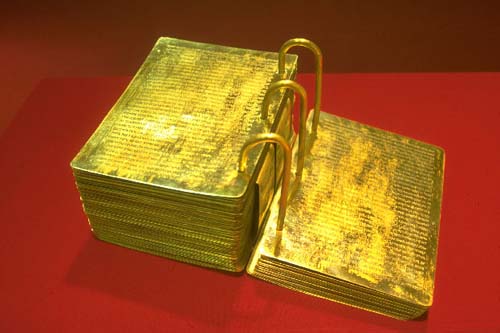
We believe that Joseph Smith was a prophet of God. How shall we know that he is a prophet? By his fruits. The most important fruit of Joseph Smith is the Book of Mormon. In the Book of Mormon, the prophet Mormon expounded on the principle that "by their works ye shall know them" using the contrast of good and bitter fountains. "For behold, a bitter fountain cannot bring forth good water; neither can a good fountain bring forth bitter water; wherefore, a man being a servant of the devil cannot follow Christ; and if he follow Christ he cannot be a servant of the devil."
Mormon continued, "Wherefore, all things which are good cometh of God; and that which is evil cometh of the devil; for the devil is an enemy unto God, and fighteth against him continually, and inviteth and enticeth to sin, and to do that which is evil continually. But behold, that which is of God inviteth and enticeth to good continually; wherefore, every thing which inviteth and enticeth to do good, and to love God, and to serve him, is inspired of God." (Moroni 7: 11-13)
The first thing to consider, either as prospective missionaries first read the Book of Mormon, or as their future investigators read it, is does the Book of Mormon invite and entice its readers to do good, to love God, and to serve him?
Early in the book, we read that the "right way" is to believe in Christ. Nephi, the first man to keep the record that would become the Book of Mormon, wrote, "I say unto you that the right way is to believe in Christ, and deny him not; and Christ is the Holy One of Israel' wherefore ye must bow down before him, and worship him with all your might, mind, and strength, and your whole soul; and if ye do this ye shall in nowise be cast out." (2 Nephi 25:29)
Nephi would later write, "And now, my beloved brethren . . . hearken unto these words and believe in Christ; and if ye believe not in these words believe in Christ. And if ye shall believe in Christ ye will believe in these words, for they are the words of Christ, and he hath given them unto me; and they teach all men that they should do good." (2 Nephi 33:10)
The second thing to consider is the promise given by Moroni, the last record keeper of the Book of Mormon. Moroni promised that if we ask God in the name of Jesus Christ, with a sincere heart, real intent, having faith in Christ, if "these things", the Book of Mormon, are not true, that God will manifest the truth of it unto us by the power of the Holy Ghost. "And by the power of the Holy Ghost," he said, "ye may know the truth of all things."
The prophet Joseph Smith was called by God to translate the Book of Mormon by the gift and power of God. God commanded Nephi and Mormon and Moroni to keep a record and to write the words of God. It is God, then, who gave us the Book of Mormon; Joseph Smith was his instrument in bringing forth the book in our day. Because Joseph was God's instrument, the Book of Mormon is considered to be a fruit of his labor. If the Book of Mormon persuades men to do good and to believe in Christ, and if it is the word of God, then Joseph Smith is a prophet of God.
President Gordon B. Hinckley said, "If the Book of Mormon is true, the Church is true, for the same authority under which this sacred record came to light is present and manifest among us today. It is a restoration of the Church set up by the Savior in Palestine. It is a restoration of the Church set up by the Savior when he visited this continent as set forth in this sacred record."
President Hinckley went on to say that, "If the Book of Mormon is true, the Bible is true. The Bible is the Testament of the Old World. The Book of Mormon is the Testament of the New. The one is the record of Judah, the other is the record of Joseph, and they have come together in hand of of the Lord in fulfillment of the prophecy of Ezekiel. Together they declare the Kingship of the Redeemer of the word, and the reality of his kingdom."
President Ezra Taft Benson called the Book of Mormon the "keystone of our religion," the "keystone of testimony," and said "Just as the arch crumbles if the keystone is removed, so does all the Church stand or fall with the truthfulness of the Book of Mormon." President Benson also counseled us to use the Book of Mormon in handling objections to the church:
"All objections, whether they be on abortion, plural marriage, seventh-day worship, etc., basically hinge on whether Joseph Smith and his successors were and are prophets of God receiving divine revelation. Here, then, is a procedure to handle most objection through the use of the Book of Mormon.
"First, understand the objection.
"Second, give the answer from revelation.
"Third, show how the correctness of the answer really depends on whether or not we have modern revelation through modern prophets.
"Fourth, explain that whether or not we have modern prophets and revelation really depends on whether the Book of Mormon is true.
"Therefore, the only problem the objector has to resolve for himself is whether the Book of Mormon is true. For if the Book of Mormon is true, then Jesus is the Christ, Joseph Smith was his prophet, The Church of Jesus Christ of Latter-day Saints is true, and it is being led to day by a prophet receiving revelation. Our main task is to declare the gospel and do it effectively. We are not obliged to answer every objection. Every man eventually is backed up to the wall of faith, and there he must make his stand."
Finally, Elder Richard G. Scott gave counsel that prospective missionaries can follow and then share with their investigators in the mission field: "Try reading the Book of Mormon because you want to, not because you have to. Discover for yourself that it is true. As you read each page, ask 'Could any man have written this book, or did it come as Joseph Smith testified?' Apply the teachings you learn. They will fortify you against the evil of Satan.
"Follow Moroni's counsel. Sincerely ask God the Father, in the name of Jesus Christ, with real intent, if the teachings of the Book of Mormon are true. Ask with a desire to receive a confirmation that the book is true. You will then know that Jesus Christ lives, that Joseph Smith was and is a prophet, and that the Church of Jesus Christ of Latter-day Saints is the Lord's Church. You will confirm that the Savior guides His Church through a living prophet. These truths will become a foundation for your productive life."
Benson, E. T. (1988). A Witness and a Warning: A Modern-Day Prophet Testifies of the Book of Mormon. Salt Lake City: Deseret Book.
Hinckley, G. B. (1959). Conference Report, October 1959.
Scott, R. G. (2003). Conference Report, October 2003.
Preparing Members and Prospective Missionaries to Share the Gospel. Disclaimer: I Have No Calling Or Authority and Cannot Speak for the LDS Church. I Write Only from My Perspective as a Returned Missionary. Any and All Mistakes are Mine Alone.
Tuesday, February 12, 2013
Thursday, February 7, 2013
Recognizing the Promptings of the Spirit
Before one can receive a witness of the Spirit, teach by the Spirit, or help others recognize spiritual feelings, they must first learn to recognize the promptings of the Spirit. President Boyd K. Packer has said, "The voice of the Spirit is described in the scripture as being neither 'loud' nor 'harsh.' It is 'not a voice of thunder, neither . . . voice of a great tumultuous noise.' But rather, 'a still voice of perfect mildness, as if it had been a whisper,' and it can 'pierce even to the very soul' and 'cause [the heart] to burn.' Remember, Elijah found the voice of the Lord was not in the wind, nor in the earthquake, nor in the fire, but was a still small voice.
"The Spirit does not get our attention by shouting or shaking us with a heavy hand. Rather it whispers. It caresses so gently that if we are preoccupied we may not feel it at all. Occasionally it will press just firmly enough for us to pay heed. But most of the time, if we do not heed the gentle feeling, the Spirit will withdraw and wait until we come seeking and listening and say in our manner and expression, like Samuel of ancient times, 'Speak [Lord], for they servant heareth.'"
Promptings of the Spirit have often been described as a "burning in the bosom," yet Elder Dalin H. Oaks had this to say: "What does a 'burning in the bosom' mean? Does it need to be a feeling of caloric heat, like the burning produced by combustion? If that is the meaning, I have never had a burning in the bosom. Surely, the word 'burning' in this scripture signifies a feeling of comfort and serenity. That is the witness many receive. That is the way revelation works."
How do we recognize the promptings of the spirit? To answer the question, President Gordon B. Hinckley once read Moroni 7:13, 16-17 and then said, "That's the test, when all is said and done. Does it persuade one to do good, to rise, to stand tall, to do the right thing, to be kind, to be generous? Then it is of the Spirit of God. . . . If it invites to do good, it is of God. If it inviteth to do evil, it is of the devil. . . . And if you are doing the right thing and if you are living the right way, you will know in your heart what the Spirit is saying to you."
President Hinckley added that, "You recognize the promptings of the Spirit by the fruits of the Spirit -- that which enlighteneth, that which buildeth up, that which is positive and affirmative and uplifting and leads us to better thoughts and better words and better deeds is of the Spirit of God."
In chapter 4 of Preach My Gospel, we find a table with a list of scriptures which gives ideas on how one might recognize the Spirit and its promptings (pages 96-97). For example scriptures such as Galatians 5:22-23 suggest that the Spirit gives "feelings of love, joy, peace, patience, meekness, gentleness, faith and hope." Doctrine and Covenants 8:2-3 says that the Spirit can give us ideas in the mind and feelings in the heart. The spirit can enlighten the mind, according to Alma 32:28 and other scriptures. The table is worth studying so that prospective missionaries can learn to recognize the Spirit.
President Howard W. Hunter explained how we can discern different manifestations of the Spirit: "I get concerned when it appears that strong emotion or free-flowing tears are equated with the presence of the Spirit. Certainly the Spirit of the Lord can bring strong emotional feelings, including tears, but that outward manifestation ought not to be confused with the presence of the Spirit itself.
"I have watched a great many of my brethren over the years and we have shared some rare and unspeakable spiritual experiences together. Those experiences have all been different, each special in its own way, and such sacred moments may or may not be accompanied by tears. Very often they are, but sometimes they are accompanied by total silence. Other times they are accompanied by joy. Always they are accompanied by a great manifestation of the truth, of revelation to the heart. . . .
"Listen for the truth, hearken to the doctrine, and let the manifestation of the Spirit come as it may in all of its many and varied forms. Stay with solid principles; teach from a pure heart. The the Spirit will penetrate your mind and heart and every mind and heart of your students."
Not only can there be difference manifestations of the Spirit for different situations, but also for different people. The way the Spirit manifests itself to one person is often different from how the Spirit manifests itself to another. We are all individuals and the way the Spirit manifests itself to us may be unique. We should learn not just to recognize the Spirit, but also how it manifests itself to us individually and uniquely.
Sources:
Missionary Preparation: Student Manual. (2005). Salt Lake City:The Church of Jesus Christ of Latter-day Saints
Preach My Gospel. (2004). Salt Lake City: The Church of Jesus Christ of Latter-day Saints.
Teaching, No Greater Call: A Resource Guide for Gospel Teaching. (1999). Salt Lake City: The Church of Jesus Christ of Latter-day Saints.
Wednesday, February 6, 2013
"Thy Timing Be Done"
We read in Preach My Gospel that, "A testimony is a spiritual witness and assurance given by the Holy Ghost. To bear testimony is to give a simple, direct declaration of belief -- a feeling, an assurance, a conviction of gospel truth. Sharing your testimony often is one of the most powerful ways of inviting the Spirit and helping others feel the Spirit. It adds a current personal witness to the truths you have taught from the scriptures. An effective missionary teaches, testifies, and invites others to do things that build faith in Jesus Christ. This includes making promises that come from living true principles."
Of course, before you can share your testimony, you have to have a testimony to share. When I left on my mission I thought I had a testimony; I had read the Book of Mormon twice and had seen my faith increase, and I had felt the Spirit testifying that what I was reading was true. But a few months into my mission I started to feel that my testimony was at best inadequate. So one night I prayed to know if the church was true, and I have to confess that I did not have much patience. When I did not receive an immediate answer I worried that, in fact, the church might not be true.
Elder Dalin H. Oaks of the Quorum of the Twelve has taught about the timing of inspiration from God: "We should recognize that the Lord will speak to us through the Spirit in his own time and in his own way. Many people do not understand this principle. They believe that when they are ready and when it suits their convenience, they can call upon the Lord and he will immediately respond, even in the precise way they have prescribed. Revelation does not come that way."
Elder Neal A. Maxwell, who was a member of the Twelve, echoed this principle: "Since the Lord wants a people 'tried in all things' (D&C 136:31), how, specifically, will we be tried? He tells us, I will try the faith and the patience of my people (see Mosiah 23:21). Since faith in the timing of the Lord may be tried, let us learn to say not only, 'Thy will be done,' but patiently also, 'Thy timing be done.'"
When I worried that the church might not be true, because I had not received an immediate witness from the Spirit, I started arguing with myself. I had wanted the church to be true, "Oh, why couldn't it be true?" But then, "No, you know it is true?" When the Lord, I think, was satisfied with my sincerity, I was prompted to ask again, an when I did I finally received the witness from the spirit that I had been seeking. While it worked out for me in the end, prospective missionaries probably shouldn't follow my example.
Rather, prospective missionaries who don't have a testimony, should follow the same formula or pattern that they will ask their investigators to follow. Prospective missionaries and investigators should follow the guidelines given by Moroni in the last chapter of the Book of Mormon:
"Behold, I would exhort you that when ye shall read these things, if it be wisdom in God that ye should read them, that ye would remember how merciful the Lord hath been unto the children of men, from the creation of Adam even down until the time that ye shall receive these things, and ponder it in your hearts.
"And when ye shall receive these things, I would exhort you that ye would ask God, the Eternal Father, in the name of Christ, if these things are not true; and if ye shall ask with a sincere heart, with real intent, having faith in Christ, he will manifest the truth of it unto you, by the power of the Holy Ghost.
"And by the power of the Holy Ghost ye may know the truth of all things." (Moroni 10:3-5)
Missionaries ask their investigators to read and pray about the Book of Mormon; prospective missionaries should do the same. With investigators, missionaries hope this process will unfold in a matter of weeks -- the time it takes to teach five discussions and for the investigator to attend church the required number of times. For prospective missionaries it may take longer, perhaps even several months; they can expect their patience to be tried.
For prospective missionaries who may feel that they do have a testimony, they should work on strengthening that testimony. How might they do that, by repeating the same process described above. They should continue studying the scriptures, the discussions they will teach, resources like Preach My Gospel, True to the Faith, etc, and seek the guidance of the Spirit through prayer. As they do this, seeking to know the will of the Lord and then doing it, their faith will increase and their testimony will be strengthened.
Tuesday, February 5, 2013
"I Know"
President Boyd K. Packer was called to be president of the New England States Mission while he was serving as an Assistant to the Twelve. In a book published in 1975, President Packer reflected on an experience he had as a mission president. He found that his mission was not progressing as it should have been, but he could not immediately discover the solution. The answer came during the testimony session of a zone conference when a particular elder stood to bear his testimony.
"The testimonies we'd heard from all the other missionaries," wrote then-Elder Packer, "went something like this: 'I'm grateful to be in the mission field. I've learned a lot from it. I have a fine companion. I've learned a lot from him. I'm grateful for my parents. We had an interesting experience last week. We were out knocking on doors and. . . .' Then the missionary would relate an experience. His conclusion would be something like this: 'I'm grateful to be in the mission field. I have a testimony of the gospel.' And he would conclude 'in the name of Jesus Christ. Amen.'
"This young elder was different somehow. Anxious not to spend an extra second on his feet, he said simply, in hurried, frightened words, 'I know that God lives. I know that Jesus is the Christ. I know that we have a prophet of God leading the Church. In the name of Jesus Christ. Amen.'
"This was a testimony. It was not just an experience nor an expression of gratitude. It was a declaration, a witness!
"Most of the elders had said 'I have a testimony,' but they had not declared it. This young elder had, in a very few words, delivered his testimony -- direct, basic, and, as it turned out, powerful.
"I knew then what was wrong in the mission. We were telling stories, expressing gratitude, admitting that we had testimonies, but we were not bearing them."
Note the clear difference between saying that you have a testimony and actually bearing your testimony. Note, also, the difference between a "thankimony" and a testimony.
During one Fast and Testimony meeting some years ago, I heard several "thankimonies" which seemed to say "I have a testimony because of this blessing or that blessing." I stood up to bear my testimony and said that I did not have a testimony because I had a great job, or a nice house, or a wonderful wife -- though I do have a wonderful wife. Rather, I had a testimony because I had received a witness from God, a witness of the Spirit. What greater witness can we have than a witness from God?
It is acceptable, when bearing testimony, to express gratitude or to tell a faith promoting story, but we should remember that doing these things is secondary to bearing testimony. The primary purpose of bearing testimony is to declare what we know. As we read in True to the Faith: A Gospel Reference, "Your testimony will be most powerful when it is expressed as a brief, heartfelt conviction about the Savior, His teachings, and the Restoration. Pray for guidance, and the Spirit will help you know how to express the feelings in your heart."
The importance of bearing testimony in missionary work cannot be overstated. "Personal testimony," said President Gordon B. Hinckley, "is the factor which turns people around in their living as they come into this Church."
President Hinckley also said that "[Testimony] is something that cannot be refuted. Opponents may quote scripture and argue doctrine endlessly. They can be clever and persuasive. But when one says, 'I know,' there can be no further argument. There may not be acceptance, but who can refute or deny the quiet voice of the inner soul speaking with personal conviction?"
While a testimony cannot be refuted, and cannot be taken away from the person who bore it, that doesn't stop people from trying. If people do not want to believe, then they will find a reason not to; if they do not want to accept a testimony, then they won't. But their actions cannot refute a witness from God and a testimony is always worth repeating.
I know that God lives, that Jesus is the Christ, the Holy Messiah. I know that the Book of Mormon is the word of God. I know that Joseph Smith was a prophet and that Thomas S. Monson is a prophet. In the name of Jesus Christ. Amen.
Sources:
Packer, B. K. (1975). Teach Ye Diligently. Salt Lake City: Deseret Book.
(2004). True to the Faith: A Gospel Reference. Salt Lake City: The Church of Jesus Christ of Latter-day Saints.
Hinckley, G. B. (1998). "Testimony". Ensign, May 1998.
Monday, February 4, 2013
The Nicodemus Factor
On my second day in my fourth area, we had a dinner appointment with the former mayor of the town. He was not a member of the church, but was considered to be a friend of the church. After dinner at a nice restaurant we went back to his home for a discussion. We talked about the gospel, the apostasy and restoration, baptism and the reason for commandments, etc.
I did not know what to make of the former mayor, he had had a long association with the church and had been taught the discussions several times. He had also read The Book of Mormon a few times. I think he believed the church to be true, and might even have known it, but he worried too much about what people would think if he got baptized. He did say that he would have had to give up all of his many ties in the community if he were baptized. He was always willing to take us out to dinner and have a discussion about the gospel, but I wasn't sure if it would really be worth our time.
I thought of the former mayor recently when I read about the nighttime visit of Nicodemus with the Savior. Nicodemus was a member of the Sanhedrin, and a prominent Pharisee. It seems that he timed his visit with Jesus in order to minimize the risk of being seen with him. He did not want to attract attention lest anyone think he was a follower of Jesus of Nazareth.
"Rabbi," said Nicodemus, "we know that thou art a teacher come from God: for no man can do these miracles that thou doest, except God be with him." It appears that the Pharisee was trying to justify this visit to himself.
The Savior surely knew that Nicodemus, while he might be an admirer, was not really a convert, and that his interest in seeing Jesus was intellectual curiosity rather that spiritual searching. As a learned man, Nicodemus's mind was in a well built box. He had been taught to be infatuated with mysteries in the scriptures, turning the simplest truth into obuscure perplexity. Having sized up his interlocutor, Jesus sought to open his mind, to get Nicodemus to think outside the box.
"Verily, verily, I say unto thee, Except a man be born of again, he cannot see the kingdom of God."
"How can a man be born when he is old," asked Nicodemus, "can he enter the second time into his mother's womb, and be born?"
In addition to opening his mind, Jesus was also trying to get Nicodemus to humble himself, to admit that he didn't know what the Savior was saying. Next Jesus hinted that he was speaking symbolically.
"Verily, verily, I say unto thee, Except a man be born of water and of the Spirit, he cannot enter into the kingdom of God. That which is born of the flesh is flesh; and that which is born of the Spirit is spirit."
There were definite clues here, references to teachings of the ancient prophets which used the "new birth" of baptism and the gift of the Holy Ghost as symbolism of natural birth. In the Book of Moses, in the Pearl of Great Price, we read this is the way it was originally taught to Adam. But as a trained Pharisee, Nicodemus could not recognize the reference. Jesus then tried to get the Nicodemus to fish or cut bait.
"Marvel not that I said unto thee, Ye must be born again. The wind bloweth where it listeth, and thou hearest the sound thereof, but canst not tell whence it cometh, and whither it goeth: so is everyone that is born of the Spirit."
One wonders if there might have been an evening breeze as Jesus tried to find evidence of spiritual curiosity in Nicodemus. One might also wonder why the Savior didn't just tell the Pharisee straight up that he needed to repent and be baptized. But Nicodemus had likely already heard that message from John the Baptist and had not accepted it. Even now, despite the efforts of Jesus to get Nicodemus to humble himself and open his mind to simple spiritual truths, the Pharisee was still locked in his box of intellectual mystery making.
"How can these things be?" he asked. While this might sound like an admission of ignorance, it was instead an intellectual thrust designed to put Jesus on the defensive. The Savior fired right back with a challenge of his own.
"Art thou a master of Israel, and knowest not these things? Verily, Verily, I say unto thee, We speak that we do know, and testify that we have seen; and Ye receive not our witness."
The "we" referred to both Jesus and John the Baptist. Nicodemus had confessed that Jesus must be a man of God to perform the miracles that he did, but he did not come to the Savior in the nighttime seeking instruction, much less repentance and baptism. Rather, he was intellectually fascinated by the Nazerene.
"If I have told you earthly things," Jesus continued, "and ye believe not, how shall ye believe, if I tell you of heavenly things?"
At this point, there was only one thing left to do, bear testimony. This is a common experience for missionaries in these latter days, as well. When a missionary has tried to open the mind of a contact or investigator, and it has not worked, it is time to start bearing their testimony. This is what the Savior now did with Nicodemus.
"And no man hath ascended up to heaven, but he that came down from heaven, even the Son of man which is in heaven. And as Moses lifted up the serpent in the wilderness, even so must the Son of man be lifted up: The whosoever believeth in him should not perish, but have eternal life.
"For God so loved the world, the he gave his only begotten Son, that whosoever believeth in him should not perish, but have everlasting life. For God sent not his Son into the world to condemn the world, but that the world through him might be saved. He that believeth on him is not comdemned: but he that believeth not is condemned already, because he hath not believed in the name of the only begotten Son of God."
The Joseph Smith Translation adds "which before was preached by the mouth of all the holy prophets: for they testified of me."
Finally to the man who came to see him at night, Jesus continued, "And this is the condemnation, the light is come into the world, and men loved darkness rather than light, because their deeds were evil. For every one that doeth evil hateth the light, neither cometh to the light, lest his deeds should be reproved. But he that doeth truth cometh to the light, that his deeds may be made manifest, that they are wrought in God."
While Nicodemus was not converted, he did remain a friend. He would defend Jesus when the Pharisees were going to condemn the Savior without a trial. Then, after Jesus was crucified, Nicodemus brought myrrh and aloes for the Savior's burial. Nicodemus may have been one of those honorable men referred to in Doctrine and Covenants 76:73-76: "These are they who are honorable men of the earth, who were blinded by the craftiness of men. These are they who receive of his glory, but not of his fullness." One might hope, however, that Nicodemus may have later, after the Savior's resurrection, accepted the gospel.
Sources:
John Chapter Three
Skousen, W. C. (1992). Days of the Living Christ, Vol. 1. Salt Lake City, UT: Ensign Publishing Co.
Thursday, January 31, 2013
Baptismal Challenge
When I had been in my fourth area for a few months we started teaching a part member family. Each week we would meet in the home of the bishop of the ward to which we were assigned. After teaching the fourth discussion about the Plan of Salvation I made a baptismal challenge to the wife, Sharon. I tied a challenge idea that I had heard about from our zone leaders a few weeks previously.
“Before
we go on," I said, "I want to stop and let you know that the feelings you are
having right now is the spirit telling you that these things are
true.” Any time the missionaries are feeling the spirit, they can be confident that their investigators are also feeling it. The spirit was very strong this night and Sharon agreed. I then
started the baptismal challenge by asking her three questions based on the seed analogy in Alma 32 (read it now if you have not done so before):
- Do you feel that your soul has been enlarged? She said yes.
- Has your understanding been enlightened? Yes.
- Have these things been delicious to you? She said yes, but that she wanted to learn more before she was baptized.
Then
I talked about Alma comparing the word to a seed before turning to
Acts chapter 2 to set up the Day of Pentacost. The people were
touched by the spirit and asked the Apostles, “Men and brethren, what shall we
do?” Peter commanded them to be baptized and immediately 3,000
were. They didn’t wait for understanding; they had received a
witness of the spirit and were baptized.
Then
I asked, “Do you believe that the spirit has been testifying to you
that these things are true?” She said yes. “If Peter were here
tonight, what do you think he would ask you?” “To be baptized,” she answered.
Now for the big one: “As servants of Jesus Christ we also would like
to extend that invitation. Will you be baptized?” She said yes!
I cannot put into words how excited I was.
We set a goal date for two to three weeks out. Sharon still
needed to attend church twice and have the last two discussions, but I was so excited because Sharon was going to be baptized!
However, there were still some challenges ahead. When we taught the fifth discussions, Sharon would not commit to date for baptism. She said she wanted more understanding before being baptized. When we taught the sixth discussion she
said that she believed the spirit is testifying to her that the
things we were teaching her were true but expressed her fear that if
she was baptized she might not be able to stay on the pathway.
The
bishop and I bore our testimonies and committed her to pray about
being baptized. I told her the long version of how I received my
testimony. The spirit was strong and sweet. We committed Sharon to
fast and pray to know that these things are true by the next week.
The next time we met we were started by setting a tentative baptismal date. Sharon said that she
had not had any earth shaking answers to her prays, but that she also
did not have any negative feelings. She said that she did feel good
when she prayed. Then we showed her and her husband the video How
Rare a Possession
and again the spirit was strong and sweet.
Then
the bishop bore his testimony and I followed with mine. I talked a
little about fear and how I could understand because I was afraid of
going home and even more so of marriage. I came to that realization
during priesthood meeting on Sunday as we had one of those lessons on
fatherhood where missionaries take mental notes for the future. I
also shared with her that famous quote by Franklin Delano Roosevelt,
“The only thing we have to fear is fear itself.”
Fear was
the actual roadblock and it is one of the devil’s best tools. If
he can make us too afraid to press forward with faith, then he has
won. Sharon agreed to take the leap and be baptized and the ceremony finally took place a week and a half later.
Baptism is a big step, and even the most golden investigator may need a little help in making the decision to take the leap of faith. Another investigator we taught in that same area was so golden we called him a "dry Mormon" -- just add water. But when it came to making the decision to be baptized John started to struggle. After teaching him the fifth and sixth discussion we had still not set a date, so all of us -- John, his friend and my companion and I -- fasted and prayed that
he would know that baptism was right and that this is the true church. The next time we met we set the date and he was baptized.
Wednesday, January 30, 2013
A Day or Two in the Life
May
27, 1988, Friday
– This was quite an eventful day. It was my turn to drive today
and our first destination was the home of one of our investigators.
Our plan was to show him the video Restoration
of the Priesthood;
apparently he has been struggling lately. Alas, he was not home, so
we went and tracted four streets, after which we went back to the
flat to pick up Elders Tippets and Vaughan to go to lunch at Wendy’s.
When we got there we just happened to run into the Carmel Ward’s
mission leader, Brother King, who picked up the tab for lunch.
We had occasion to drive by the beach and we saw a destroyer and a submarine out in the bay. That was totally awesome. Later in the evening, when the sun had gone down, we were up in the hills and I could see the lights of the ship and sub.
At 6:30 p.m. we had our teaching appointment with Charles, who lives in our apartment complex. We talked for two and a half hours; Charles and his friend Tim had come prepared with a few so-called contradictions between Joseph Smith and the Book of Mormon. We spent the time answering questions, bearing testimony, and promising to study up on the subjects we did not have answers for. I am afraid that we got into a little bashing. I was trying to keep control of the situation but they were anything but cooperative. But I still tried to keep the spirit there.
Among their concerns were the following:
- The book Doctrines and Salvations states that the Book of Mormon contains the fullness of the gospel, yet it has no mention of baptism for the dead or celestial marriage, and neither does the Bible. I was able to point out baptism for the dead is mentioned in First Corinthians 15:29, “Else what shall they do which are baptized for the dead, if the dead rise not at all? Why then are they baptized for the dead?” For celestial marriage I mentioned First Corinthians 11:11, “Nevertheless neither is the man without the woman, neither the woman without the man, in the Lord.” Charles said this was taken out context. Besides, there is Matthew 22:30 said Charles, “For in the resurrection they neither marry, nor are given in marriage, but are as the angels of God in heaven.”
- Moroni 8:18 says that God is not partial, neither changeable, being an unchangeable being from all eternity to all eternity. Numerous scriptures in the Bible and Book of Mormon point out the same. Yet Joseph Smith in the King Follet Discourse stated that God is an exalted man. Joseph said that we have believed for a long time that God was always God and then said, “I will refute that idea.” Okay, he stumped us on this one, but then Charles did not say that Joseph had said God was an exalted man. Anyway, we admitted our confusion and promised to study up on it.
- Certain prophecies of Joseph Smith have not come to pass in the time frame prophesied. Joseph apparently made some false statements, refuting or contradicting the Bible or the “Word” as they said. Deuteronomy says that false prophets will come and if they say something that is not in the “Word” the must needs be destroyed. Of course, Joseph Smith was killed.
We
did our best in answering their questions. I told them of how I got
my testimony and threw in Moroni’s Promise. We tried to tell them
it all depended on whether the Book of Mormon was true or not. We
had a prayer at the end, and the way we did it was unusual; they
wanted all four of us to pray aloud at the same time. The prayers of
me and my companion were relatively short, but they used a lot of
repetition.
I could have sworn that I heard Tim pray in a different language. Charles and Tim are in the Air Force and are here students at the Defense Language Institute in Monterey. That might be why.
We returned to the flat thinking our day was done, but at 10:10 p.m. we got a call from a member. They had a friend at their house who really needed a priesthood blessing. We quickly got dressed and headed over. At the members’ home was Rowan Adams McClure, who had been driving from San Diego to the VA hospital in San Francisco; his records are being sent there from Salt Lake City. While driving he began to experience a pinched nerve, he had almost no strength in his right arm, so he got off the Pacific Coast Highway at Seaside to visit his friends.
Elder Spaugh did the anointing and I did my first sealing and blessing. The man specifically asked me to give the blessing. The spirit only impressed me with what to say, which wasn’t much, he didn’t tell me directly. It was a challenge to figure out how to phrase what I was impressed to say. I blessed him with peace and that he would be well enough to travel in the morning.
With that done we came back to the flat and finally went to bed. Wow, what a day. These days are filled with so many experiences, but they go by so quickly.
May 28, 1988, Saturday – We went to the library at the stake center to do some research. I read Joseph Smith’s King Follet Discourse and also photocopied it. Here is what we came up with as answers to each of Charles’ and Tim’s concerns:
- Mormon Doctrine says that what is meant by the fullness of the gospel is what the Nephites had and needed.
- In the footnotes of Moroni 8:18 we see that God is unchangeable in his perfectness. John 5:19 states that Son can do nothing but what he seeth the Father do. As we read in the King Follet Discourse, Joseph Smith says that the Father is an exalted man. The Father did what Jesus did; He was the Savior of a world or worlds before he became the Eternal Father and created this world.
- Elder B. H. Roberts said that Joseph Smith reached his height as a teacher in the King Follet Discourse given at the funeral of Brother Follet in April 1844. There was only one thing left for him to do, seal his testimony with his blood, which he did three months later. Such is not the life of a fallen prophet. As for unfulfilled prophecies, Charles mentioned a statement of Joseph Smith that he will dedicate the temple in Independence, Missouri, and said that it cannot be fulfilled because Joseph is dead. Elder Tippets pointed out “He can do it with resurrected hands.”
Charles
stopped by our apartment tonight and we had another long chat. We
presented to him the answers we had come up with in our research.
After a little back and forth, thrust and parry, I taught him parts
of the first, third and fourth discussions -- I kind of just took over. He interjected once but
I then asked if I could continue without interruption.
I proceeded to teach him the Joseph Smith story, the restoration and apostasy, and the plan of salvation complete with the pre-mortal sphere, the mortal sphere, sin and death, the Atonement of Christ, the spirit world with paradise and prison, baptism for the dead, judgement and the three degrees of glory. I then bore my testimony and expressed my gratitude for the plan of salvation and for my Savior. I explained the sacrifices involved in serving a mission. Throughout it all, Charles was completely silent.
I tried to teach with the spirit and with love and sincerity. The spirit was present and it was strong. I challenged him to read Alma 32 and to pray about the Book of Mormon and about the things we discussed this evening. Then we closed with a prayer; this time only I said it. I didn’t need the distraction of another person praying and I wanted him to see an example of an LDS prayer.
If you don't know the answer to a question or concern, it is perfectly acceptable to tell your investigators that you will do some research.
Subscribe to:
Posts (Atom)